
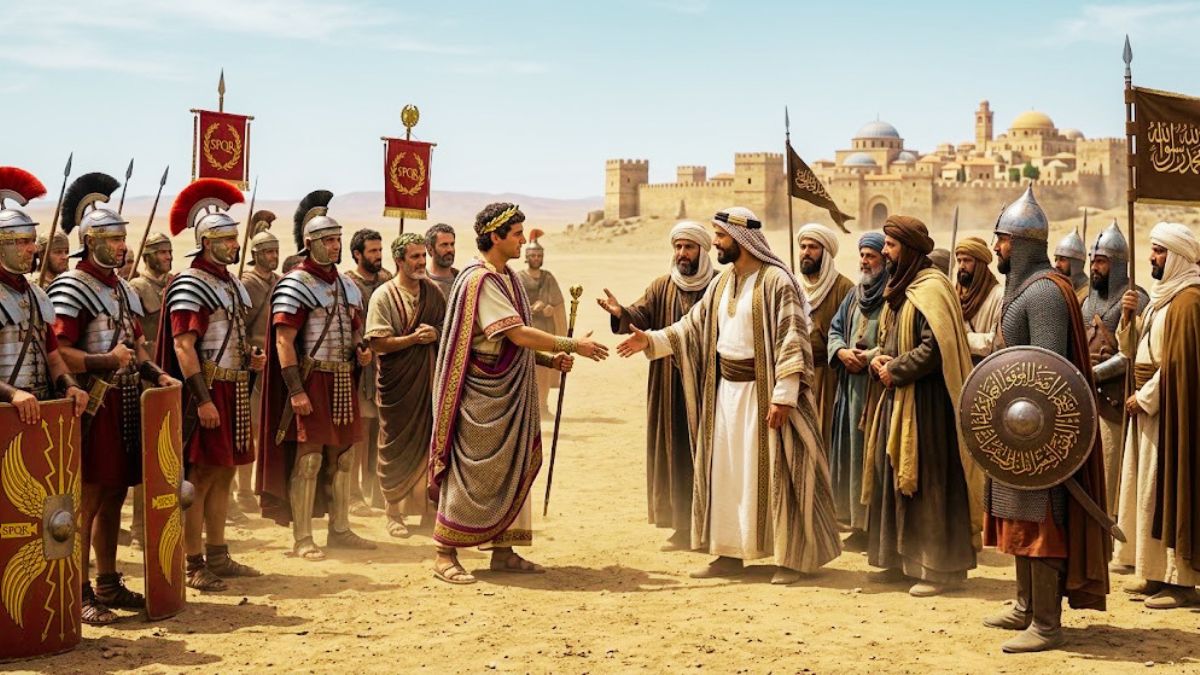
Explore the uncanny parallels between the Roman Empire and Islamic Caliphates. Strip away theology and regional bias to discover how both civilizations navigated identical political lifecycles—evolving from consensus-driven foundations and masked dynastic transitions into massive, centralized imperial autocracies driven by the universal mechanics of human ambition and power.
The Universal Law of Empires: Why Rome and the Caliphates Ran the Exact Same Race
Traditional scholarship tends to quarantine Roman civilization and Islamic history into two separate, rival worlds. Academic conventions treat them as isolated realms across a deep civilizational divide. Consequently, each faction seeks to claim distinct moral, political, or cultural superiority over the other.
Strip away the theological rhetoric and regional biases, however, and you uncover the same fundamental raw material. Both systems were built by human beings grappling with the mechanics of power, territory, and ambition.
Because human nature does not change with geography or creed, the structural patterns of statecraft remain universal. When you place the rise and transformation of Rome side by side with the early Caliphates, the resemblance is unmistakable. Both civilizations walked the exact same political road, confronting identical institutional traps at every milestone.
The Imperial Stopwatch: Rome Simmered While the Caliphate Sprang
There is, however, one glaring difference between the two trajectories: the clock.
Rome’s political and administrative evolution was a slow, gradual burn stretched across five centuries. From the expulsion of the Tarquin kings in 509 BCE to the rise of Augustus in 27 BCE, Rome learned statecraft through generations of bitter domestic friction. It fought long border wars, resolved internal class struggles between Patricians and Plebeians, and digested its Mediterranean conquests gradually.
In contrast, the early Caliphates hit fast-forward.
The early Islamic state exploded out of the Arabian peninsula with breathtaking velocity. Within barely eighty years, its armies swept across the entire Persian Sasanian realm and swallowed two-thirds of the Byzantine Empire. Its borders stretched from the Atlantic coast of Spain to the frontiers of India in three generations.
Rome played its imperial tape at normal speed across half a millennium. The Caliphates were forced into a high-speed crash course, compressing five hundred years of Roman growing pains into decades. Yet despite this wild disparity in speed, the structural milestones remained identical. Both societies passed through three distinct phases: the consensus foundation, the masked transition, and the absolute imperial transformation.
The Consensus Foundation: The Roman Republic and the Rashidun
Every lasting empire begins with a profound rejection of absolute autocracy.
The Roman Republic was founded on an explicit hatred of kings. After banishing their Etruscan tyrants, Romans designed a shared system of governance anchored by the Senate and elected magistrates. Power rested upon custom, collective elite participation, and institutional suspicion of concentrated executive rule. Leaders derived their legitimacy from the republic rather than personal royal privilege.
Centuries later, the early Islamic community faced an identical administrative question following the death of its messenger. The answer was the Rashidun era, governed by consultation, or shura.
Like the Roman Senate, the early leadership in Medina rejected dynastic monarchy. The first caliphs were chosen through consensus among elder companions and tribal leaders. They lived modest, accessible lives, walked the dusty markets, and owned little personal property. Legitimacy came from shared moral character, communal consultation, and fidelity to foundational principles rather than an imperial lineage.
Yet both systems contained the seeds of their own undoing. Republics and consultative councils function brilliantly for compact city-states and tight regional coalitions. They collapse under the weight of sudden, massive geographic expansion.
As Roman generals conquered Spain, Greece, and Gaul, enormous wealth flooded into Rome. The spoils of war enriched military commanders, strained traditional checks, and ignited brutal civil conflicts. The old senatorial machinery could no longer police ambitious warlords who commanded loyal, distant legions.
The Rashidun structure cracked under the exact same structural strain. Immense provincial wealth flowed into Medina from conquered Persian and Syrian lands. Rival factions disputed tax revenues, provincial governors operated like kings, and tribal rivalries resurfaced. The system could not bear the administrative load, culminating in the first civil wars, known as the First Fitna.
The era of simple consensus had died. Massive global empires cannot run on town-hall meetings.
The Masked Transition: The Roman Principate and the Umayyad Dynastic Shift
When institutions fracture, strongmen step in to stabilize the realm by transforming the system from the inside out. Crucially, neither the Roman nor the Arab reformer dared to call themselves an outright king right away. They hid autocracy beneath old, comfortable titles.
In Rome, Julius Caesar’s adoptive son Octavian emerged victorious from the ashes of civil war. He understood that the Roman people despised the word rex (king). Therefore, Octavian took the title of Augustus and created the Principate.
Augustus claimed he was merely the princeps—the “first citizen.” He preserved the Senate, retained traditional elections, and pretended to restore the old Republic. In reality, he controlled the treasury, held absolute military command, and created a hereditary dynastic system. It was an autocracy wrapped in the beloved clothing of the ancient constitution.
Now look at Damascus under the Umayyad Caliphate.
Muawiya emerged from the civil wars with clear political pragmatism. He recognized that a sprawling empire could no longer be managed by informal councils in Medina. Consequently, he shifted the imperial capital to Damascus, an ancient Greco-Roman administrative center.
Muawiya did not claim to invent a new religion or destroy the caliphate. Instead, he kept the revered title of Caliph, presenting himself as the protector of the faith. Beneath that traditional title, however, he founded a hereditary, dynastic Arab kingdom. He designated his son Yazid as his successor, forever abandoning the early election process.
The Umayyads walked the exact same tightrope as Augustus. They ruled like Roman emperors while keeping one foot in desert tribal customs. They minted Byzantine-style coins, employed Greek-speaking imperial clerks, and ruled through a privileged aristocratic elite.
Both the Principate and the Umayyads served as bridge regimes. They were transitional beasts: half-republican memory, half-imperial reality. But that intermediate compromise could not last forever.
The Absolute Transformation: Diocletian’s Dominate and the Abbasid Court
Eventually, empires strip away the polite legal fictions. When intermediate dynasties face internal rebellions and border crises, they centralize power completely, adopting the full trappings of sacred, unapproachable autocracy.
Rome reached this terminal phase in 284 CE through Diocletian. After the Third Century Crisis nearly tore the empire apart, Diocletian abandoned all pretenses of the old Republic. He cast aside the modest title of princeps and declared himself dominus, meaning absolute lord or master.
Under the Dominate, the emperor became a semi-divine figure secluded behind thick palace walls. Citizens could no longer approach him casually. Instead, petitioners had to practice adoratio—prostrating themselves flat on the marble floor to kiss the hem of his imperial purple robe. Diocletian adopted elaborate Persian court ceremonies, centralized the tax bureaucracy, and ruled through raw administrative hierarchy.
Centuries later, the Abbasid Revolution duplicated this exact evolution when it toppled the Umayyads in 750 CE.
The Abbasids moved the imperial capital further east to Baghdad, right into the ancient heartland of the Persian Sasanian Empire. Like Diocletian, the Abbasid caliphs shed the modest, accessible demeanor of early Arab leaders. They embraced comprehensive eastern imperial pageantry.
The Abbasid Caliph became an unapproachable sovereign, declaring himself the “Shadow of God on Earth.” He sat hidden behind ornate silk tapestries in majestic circular halls. Courtiers had to kiss the ground before his throne, practicing the exact prostration that Zoarastrians had reserved strictly for prayer. An executioner stood silently behind the throne with a leather execution carpet, ready to strike down anyone who displeased the ruler on the spot.
Like Rome under the Dominate, Baghdad was run by a massive, professional civil bureaucracy. Power was wielded by viziers, royal couriers, and professional tax administrators. The transition was total. The modest desert leader had transformed into a cosmic, untouchable monarch.
The Universal Machinery of Statecraft
When you view history through this comparative lens, artificial ideological walls begin to crumble. We discover that civilizations do not evolve along disconnected, mystical tracks. They operate under universal, predictable mechanics of power and scale.
Republics and consultative councils offer initial moral cohesion and high communal trust. However, rapid geographic expansion generates vast logistical complexity that early tribal structures cannot sustain.
To prevent utter collapse, leaders introduce military strongmen who centralize power under the guise of familiar traditions. Finally, as empires mature and govern diverse populations, the mask slips entirely. The state embraces centralized bureaucracy, sacred autocracy, and distant majesty to command obedience.
Rome did not invent this sequence, nor was the Caliphate an isolated anomaly. Both empires were simply human beings responding to the immense, crushing weight of global dominion. When the scale of territory expands beyond human sight, the structural response of human power remains forever the same.
Even sacred scripture recognized this unbroken continuum. Surah Ar-Rum (Quran) famously foretold that Rome commands an enduring destiny. Its imperial spirit outlasts ruin, rising anew after every collapse. For a deeper analysis of this eternal resurgence and its geopolitical echoes, read on Rome’s cyclical rebirth.
Unraveling the Truth in DOGMA
To explore how raw politics and human ambition shaped the history behind the legends, explore my historical fiction novel, DOGMA. The story follows two rival scientists determined to prove each other wrong. Through advanced time travel, they journey directly into the ancient Levant. However, witnessing raw historical events firsthand shatters their assumptions, exposing centuries of manufactured dogma.
The Destiny of the Nazarene Movement
Meanwhile, the true legacy of the Nazarene movement did not vanish with the fall of Jerusalem. Instead, its revolutionary monotheistic vision quietly shifted into the desert sands, awaiting its final historical revival. To trace where these scattered believers fled next, read article, The Masada Mystery.

DOGMA by Don Peter — Click the cover to get your copy
The Journey Continues
The silent stones of the ancient world continue to speak across the millennia. They urge us to study their structural triumphs and failures before our own modern empires face a similar decline.
Want to stay connected with the research, stories, and ongoing debate?
 Join the Discussion on Substack
Since this pillar post doesn’t feature a comment box, Substack is the best place to share your thoughts, ask questions, and join the conversation directly with me.
 Follow the Creative Process on Medium
Read my regular historical insights, character sketches, and reflections on the creative writing journey.