
Does evolution contradict faith? Explore the “Viceroy” theory of Adam, the 60,000-year cognitive leap forward, Y-chromosomal genetics, and Quranic scripture. Discover how evolutionary biology and divine creation unite to form a single cohesive narrative of human origins.
The Cultural War of Human Origins
For decades, an intense debate has divided theologians and evolutionary biologists. Biblical creationism traditionally argues that religious faith must take precedence over scientific discovery. In contrast, evolutionary science asserts that Earth’s 4.5-billion-year timeline proves life resulted from natural selection rather than an instantaneous divine act.
To secular scientists, our earliest ancestor was a primitive single-celled organism evolving out of inorganic compounds. To traditional creationists, humanity began instantaneously with a single man named Adam. But what if this fierce cultural debate is built on a false dichotomy? What if scientific evolution and divine creation are simply two halves of the exact same engine?
Skeptical researchers often feel uneasy about creation because it implies a divine Architect. Conversely, religious communities frequently fear that evolutionary theory seeks to erase God entirely. Yet, when we examine ancient scripture alongside modern genetics, we uncover a profound bridge that satisfies both rigorous intellect and spiritual faith.
The Limits of Theistic Evolution
Some prominent scientists attempt to bridge this divide through middle-ground theories. American physician-geneticist Francis Collins famously advocated for “Theistic Evolution.” This perspective accepts evolutionary biology as factual while proposing that God set the initial physical laws in motion.
While theistic evolution provides a helpful starting point, it often struggles to explain the physical appearance of Adam. If all life appeared simultaneously in a literal Garden of Eden, how can we reconcile that account with a 3.5-billion-year fossil record? Furthermore, mainstream evolutionary biologists routinely reject any model where a single figure like Adam halts or redirects natural selection.
To resolve this conflict, we must examine how evolutionary biology actually functions. More importantly, we must examine what sacred texts explicitly reveal about the origin of life.
The Biological Timeline: Life Out of Water
Our planet formed roughly 4.5 billion years ago. The earliest undisputed fossil evidence confirms that single-celled life emerged in oceanic environments at least 3.5 billion years ago. Over vast epochs, simple organisms evolved into complex multicellular life, eventually populating the land and skies.
In the nineteenth century, naturalist Charles Darwin shattered the traditional view of independent, instantaneous creation. During his five-year voyage aboard the HMS Beagle, Darwin collected extensive biological specimens and ancient fossils across multiple continents.
Darwin demonstrated that plant and animal species were not created in static, isolated forms. Instead, all living organisms descended from common ancestors through natural selection. Evolution is not a finished historical event, but an ongoing process that continues to shape life on Earth today.
Quranic Scripture and Evolutionary Discovery
Interestingly, Islamic scripture offers a profound clue that aligns remarkably well with modern evolutionary science. Surah Al-Anbiya reveals a foundational principle regarding the biological origin of species:
“Have not the disbelievers seen that the heavens and the earth were one entity, and We parted them, and We created every living thing out of water? Will they then not believe?” (Quran 21:30)
Many religious adherents assume that all living species appeared suddenly in their modern forms. However, this foundational verse explicitly states that creation is a process fundamentally rooted in water.
Water serves as the indispensable requirement for all biological life and the starting point of evolutionary theory. When read carefully, the sacred text does not merely tolerate evolutionary concepts. It directly supports a water-to-life trajectory.
The “Viceroy” Mystery: Re-evaluating Adam
The primary obstacle in reconciling science and faith remains the figure of Adam. If archaic hominids existed for millions of years, how could Adam be the “first” human? The answer lies in the precise linguistic terms used in scripture.
In Surah Al-Baqarah, God announces a specific mandate to the angelic host:
“And when thy Lord said unto the angels: Lo! I am about to place a viceroy (Khalifa) on the earth…” (Quran 2:30)
The angels respond with immediate concern, asking why God would establish a ruler who would cause corruption and shed blood. This dialogue contains a crucial detail that scholars often overlook.
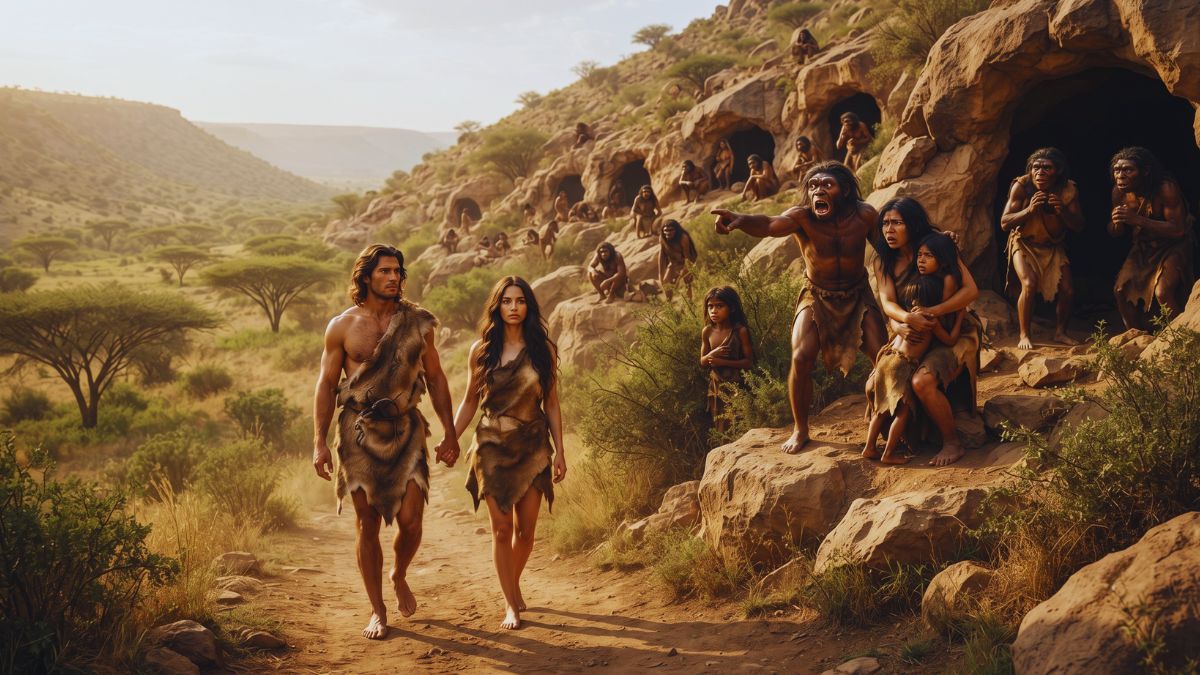
How could the angels anticipate that humans would shed blood unless they had already witnessed pre-Adamic populations? The angels had observed archaic hominids living by the brutal laws of the jungle. Like modern chimpanzees using rocks and sticks to kill rivals, early hominids were locked in a chaotic, primal fight for survival.
Adam as the First Spiritual Emissary
Under this framework, Adam was not the first biological hominid to walk the earth. Instead, he was the first Viceroy—a divinely appointed emissary sent to elevate humanity above animal instinct.
While pre-Adamic hominids relied purely on physical survival mechanisms, Adam received a transformative gift: higher abstract knowledge. The Quran records that God taught Adam “all the names,” symbolizing the birth of complex language, symbolic categorization, and moral reasoning.
This divine intervention granted Adam’s lineage the cognitive framework required to rise above brute force. Through language and moral accountability, Adamic humanity gained the capacity to build structured, ethical civilizations.
The 60,000-Year “Great Leap Forward”
The physical fossil record confirms that primates diverged from other mammals roughly 85 million years ago. By 1.8 million years ago, Homo erectus walked upright and utilized basic stone axes. However, around 60,000 years ago, an astonishing shift occurred in the archaeological record.
Before this era, hominids lived as basic hunter-gatherers with simple tools. Their populations frequently dwindled due to harsh glacial climates and brutal inter-group warfare. They lacked symbolic art, complex syntax, and long-term planning.
Then, abruptly, modern humans mastered representational art, complex language, rapid innovation, and long-distance travel. Anthropologists label this sudden explosion of culture the “Great Leap Forward.” From a theological perspective, this marks the physical manifestation of the Adamic influence.
The Power of Introspection and the Soul
Prior to this cognitive explosion, human populations faced potential extinction. While early hominids had tamed fire nearly 500,000 years ago, they lacked a creative spark. The higher knowledge granted to Adam enabled his descendants to innovate rapidly.
The most vital gift granted to Adam was introspection—the capacity to analyze one’s own conscious thoughts. While animals react instinctively to external stimuli, Adam possessed self-awareness.
This internal reflection represents the definitive hallmark of the human soul. It marks the precise transition where Bashar (purely biological man) evolved into Insan (morally conscious human).
The Mystery of the Adamic Spark
Modern genetics confirms that all living humans descend from a single Scientific Adam. Yet a fascinating mystery remains unsolved. Did a fully modern Adam appear suddenly with our exact physical form, or did a divine awakening transform an existing hominid into a conscious, knowledge-seeking human? Either scenario marks the precise moment where primal biology met divine purpose.
Scientific Adam and Genetic Ledgers
Modern genetic research offers striking confirmation of a singular human origin. Despite our diverse physical appearances, geneticists prove that all eight billion humans on Earth share a common ancestral root.
Human DNA functions as an unalterable historical ledger. Scientists track paternal lineage using the Y-chromosome, which passes directly from father to son across generations. By analyzing global genetic variations, researchers trace every living male back to a single ancestral source known as “Y-Chromosomal Adam.”
Intriguingly, geneticists calculate that this “Scientific Adam” lived approximately 60,000 to 90,000 years ago. This timeline does not match three-million-year-old hominid fossils, but it aligns perfectly with the Adamic “Viceroy” model and the “Great Leap Forward.”
The M-168 Mutation and Global Expansion
Geneticists identified a specific marker known as the M-168 mutation, shared by over ninety percent of non-African men worldwide. This marker points back to a single lineage that migrated out of Africa to populate the globe.
This super-ancestor line spread rapidly, carrying advanced cognitive capabilities into every continent. The M-168 marker stands as genetic evidence of a dominant ancestral line whose lineage reshaped the world.
Through this genetic bottleneck, the descendants of Adam carried their unique intellectual spark into existing geographic regions, establishing modern human culture everywhere they settled.
Solving the Procreation Dilemma
A long-standing objection to traditional creationism involves the procreation of Adam and Eve’s children. If humanity began with a single isolated pair, their immediate children would have been forced into sibling incest to propagate the species.
The “Viceroy” framework resolves this biological dilemma completely. Because Adam was placed among an existing global population of Homo sapiens, his immediate descendants did not need to marry siblings.
Instead, Adamic children interbred naturally with the wider surrounding populations of contemporary hominids. This integration allowed the Adamic genetic profile and spiritual capacity to spread rapidly across existing communities.
The Genetic Wall of Archaic Hominids
Ancient DNA analysis proves that modern Homo sapiens frequently coexisted and interbred with archaic hominids like Neanderthals and Denisovans. Most non-African populations today retain between one and two percent Neanderthal DNA, proving that interbreeding occurred.
However, research led by geneticists like Fernando Mendez reveals a striking phenomenon: the Neanderthal Y-chromosome vanished entirely from the modern human gene pool.
Genetic evidence suggests a biological wall. Male Neanderthal fetuses conceived with Homo sapiens females often triggered immune rejections, leading to miscarriages. Consequently, while autosomal DNA merged, the Adamic paternal lineage completely replaced archaic hominid male lines.
The Rapid Absorption of Archaic Lines
In Asia, Homo sapiens interbred with Denisovans, leaving genetic traces in modern Melanesian and Han Chinese populations. Similarly, in Africa, early modern humans encountered archaic populations, resulting in thousands of historic interbreeding events.
This constant genetic mixing ensured that the Adamic intellectual capacity spread like a wildfire across every continent. Within a few thousand generations, older archaic hominid species like Homo erectus and Neanderthals became extinct.
They were not merely destroyed through warfare; rather, they were genetically absorbed into the more adaptable, intellectually superior Adamic family.
A Fuel for Historical Thrillers
This dynamic synthesis of evolutionary science, archaeology, and sacred text provides rich fuel for historical literature. In my novels, God’s Viceroys (published in hardcover as The Viceroys of God), I explore the tension between our physical biological vessel and our divine soul.
Writing about the pre-Adamic world allows us to imagine an era of raw, instinctual survival. We can contrast that ancient landscape with the exact moment humanity received higher language, moral choice, and artistic expression.
My protagonists struggle with the same fundamental questions we face today: Are we merely advanced primates driven by instinct, or are we spiritual custodians entrusted with a divine purpose?
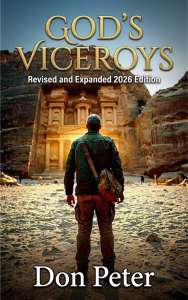
Click here to purchase God’s Viceroys
Conclusion: Two Truths, One Unified Story
Scientific evolution and the sacred account of Adam are not opposing forces. Instead, they represent two complementary aspects of one reality:
Scientific evolution explains the 3.5-billion-year development of the physical biological vessel.
The creation of Adam marks the divine infusion of the soul, higher intellect, and moral accountability.
Without evolutionary biology, there is no physical body suited for terrestrial life. Without Adam, there is no civilization, higher ethics, or abstract thought. We are simultaneously the products of a 3.5-billion-year biological journey and a 60,000-year spiritual awakening.
Without the Adamic transformation, humanity would have remained trapped in primal survival alongside other primates. But through Adam, we gained the capacity to comprehend our history, explore the cosmos, and connect with our Creator.
This epic story lies at the very heart of my novel, God’s Viceroys. Through the lens of an intense historical thriller, the narrative explores the exact moment humanity received its divine mandate. You can explore these deep historical mysteries by following the link below to my latest work.
Discover Another High-Stakes Historical Mystery
If you enjoy thought-provoking stories that challenge conventional history, explore my next historical thriller, DOGMA: Untold History of Early Christianity & Islam. This gripping novel follows two brilliant scientists who travel back through time to uncover the raw, unvarnished truth behind their deepest beliefs. Available now in eBook format, DOGMA delivers an unforgettable journey through time, faith, and ancient secrets.
The Journey Continues
The silent stones of the ancient world continue to speak across the millennia. They urge us to study their structural triumphs and failures before our own modern empires face a similar decline.
Want to stay connected with the research, stories, and ongoing debate?
 Join the Discussion on Substack
Since this pillar post doesn’t feature a comment box, Substack is the best place to share your thoughts, ask questions, and join the conversation directly with me.
 Follow the Creative Process on Medium
Read my regular historical insights, character sketches, and reflections on the creative writing journey.