
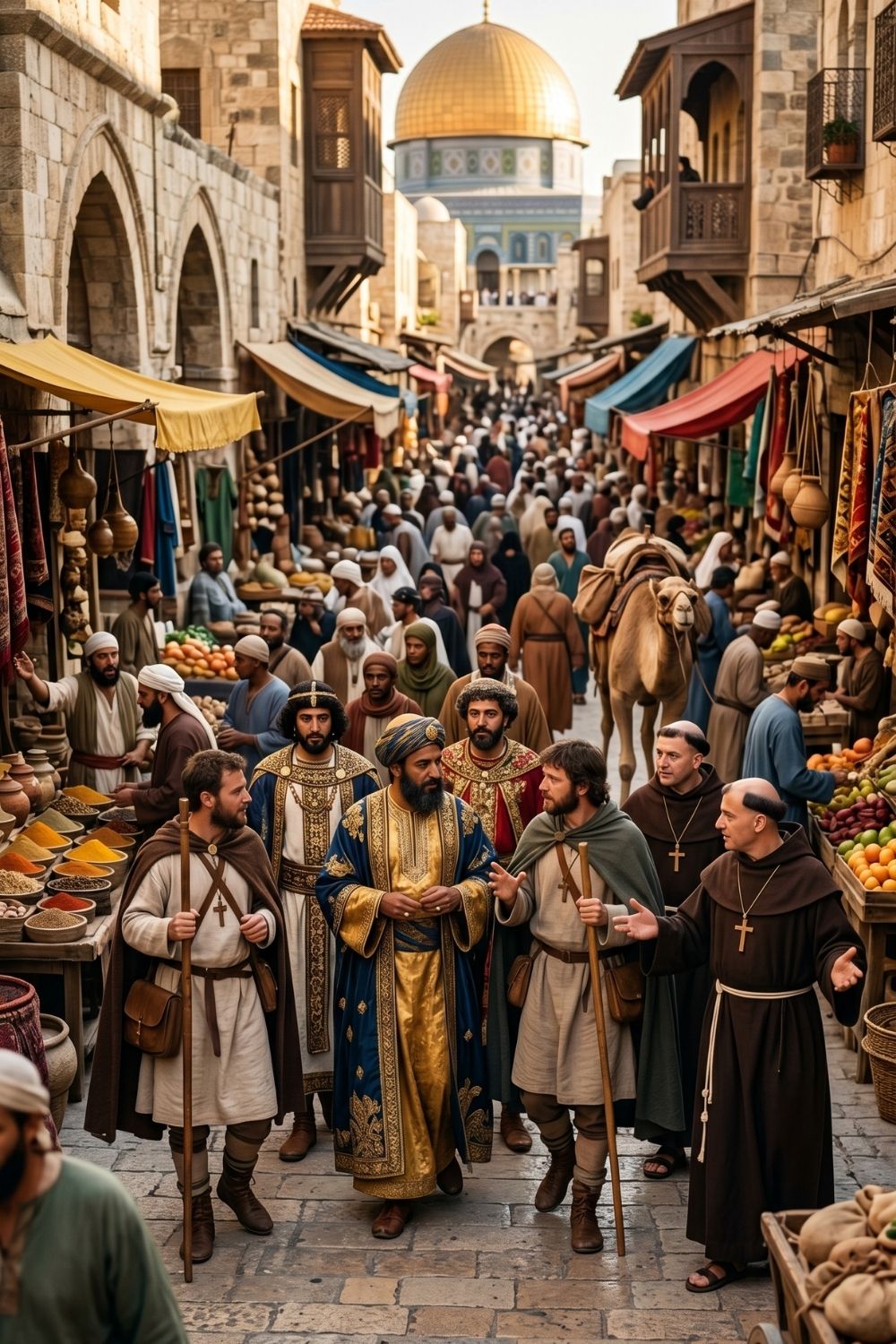
Explore the untold history of the Umayyad Caliphate and the early Mu’min movement. Discover how a pragmatic Mediterranean empire transitioned from the Rashidun era to a stable dynasty. From the meeting of Umar and the Patriarch to the “Umar Assurance” in Jerusalem, uncover a lost vision of Islamic tolerance.
History is often a silent void between the death of Muhammad and the rise of the Abbasids. Traditional accounts focus on the Abbasid era because they were the victors. They painted the Umayyads as godless kings. But the physical evidence—the coins, the tax receipts, and the buildings—tells a different story.
The Mediterranean Continuity
The Umayyad Caliphate was not a break from the Rashidun era; it was its fulfillment. Except for Ali, the early leaders were deeply tied to the Umayyad clan. While the Rashidun were elected by consensus, the Umayyads shifted to a dynasty. This move stabilized the empire. It allowed the “Mu’min Movement” to explode out of the desert and absorb the Byzantine and Persian worlds in less than a decade.
A Movement of Believers
The early followers were not “Muslims” in the modern sense. They were a loose federation called the Mu’minun (Believers). They weren’t bound by rigid Sharia or a centralized language. Instead, a single, simple creed unified them: Belief in God, the Last Day, and the performance of righteous deeds.
This was a “Big Tent” movement. It included:
Pagan Arabs who still cherished the ancient pilgrimage to Mecca.
Byzantine Christians who provided the administrative “gears” and military strategy.
Jewish Scholars who preserved the ancient texts.
Persian Zoroastrians who brought rituals like the five daily prayers.
The Encounter: Umar and the Patriarch
When the Mu’min reached Jerusalem, the world witnessed a meeting of giants. Patriarch Sophronius, a Greek scholar and leader, refused to surrender the city to anyone but the Caliph himself.
Non-Muslim records, including those from the Patriarchate, describe Umar’s arrival. He did not come with an army of conquerors. He arrived on a single camel, sharing the ride with his servant. Sophronius, dressed in regal Byzantine silk, was stunned. He saw a man in dusty rags who spoke of the same God he worshipped.
The Miracle of the Holy Sepulchre
The most spectacular moment occurred at the Church of the Holy Sepulchre. Sophronius invited Umar to pray inside the church. Umar refused.
His reason was purely pragmatic and just. He knew that if he prayed inside, later generations of his followers would claim the church as a mosque. To protect the Christian site, he stepped outside and prayed on the pavement. Today, the Mosque of Umar stands exactly where he knelt, facing the church he refused to take.
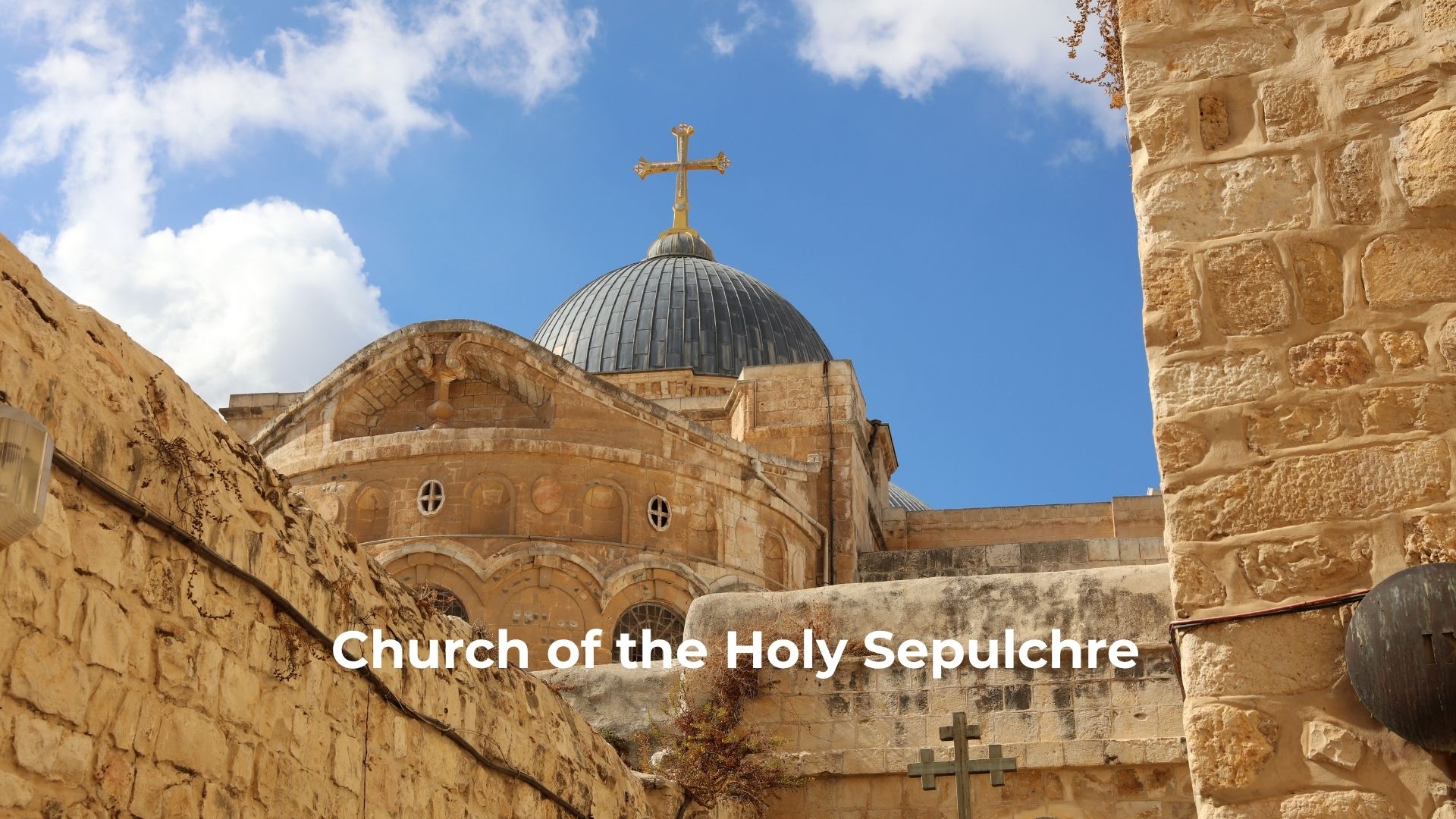
VISIT TO JERUSALEM
For a visitor, the Church of the Holy Sepulchre is the heart of the “Mu’min” story. It is where the tolerance of the early movement was etched into stone.
The Living Miracle: The Keys of the Sepulchre
If you want to see the “gears” of early Islam’s soul, you must stand in the courtyard of the Church of the Holy Sepulchre. Look up at the heavy wooden doors. There, you will witness a tradition that has survived nearly a millennium.
Since the era of Saladin—following the precedent set by Umar Al-Khatab—the keys to this most holiest of Christian sites have been held by two Muslim families: the Joudeh and the Nusseibeh.
Every morning, a Muslim hand unlocks the church. Every evening, a Muslim hand locks it.
Why a Muslim Must Visit This Site
For many Muslim travelers, Jerusalem begins and ends at Al-Aqsa. But your journey is incomplete without walking the few hundred meters to this courtyard. Here is why:
To Witness the “Umar Assurance”: When you stand here, you are standing on the ground where the Second Caliph defined Islamic justice. By refusing to pray inside the church, Umar didn’t just save a building; he saved the reputation of the Mu’min movement for all time.
A Lesson in Leadership: In a world of friction, this courtyard is a sanctuary of “The Great Peace.” It proves that the early Caliphate was not about erasure, but about guardianship.
The Physicality of Faith: Seeing a Muslim family hold the keys to a Christian sanctuary is a powerful “recharge” for the soul. It reminds us that our history is rooted in being the “Protectors of the People of the Book.”
The Most Memorable Experience
The moment you will never forget? The “Handover.” Try to be there at dawn or dusk. Watching the neutral, respectful coordination between the Muslim key-holders and the Christian friars is like watching a heartbeat. It is the pulse of the original Mu’min movement—quiet, disciplined, and profoundly just.
For a Muslim visitor, this is more than a tourist stop. It is a pilgrimage to the roots of our own tolerance. It is where you realize that the Harvest of Peace only grows when it is planted in the Soil of Justice.
From Democratically Elected to Dynastic Rule
The transition was born in blood. A chaotic civil war erupted between Mu’awiya I (the first Umayyad Caliph) and Ali ibn Abi Talib. This conflict, known as the First Fitna, ended with the assassination of Ali and the rise of the Umayyad house. From this moment on, the Caliphate was no longer elected by consensus. It became a hereditary dynasty.
The Machiavellian Reality
The Umayyads were the original political realists of the medieval world. Centuries after, the Renaissance writer Niccolò Machiavelli argued that a ruler must be both a lion and a fox, and the Umayyad Caliphs were already living that philosophy.
They understood a brutal truth: in the “jungle” of 7th-century politics, a “perfect” system of idealism often leads to collapse. To ensure the survival of the Mu’min movement, they prioritized stability over sentiment.
Dynasty vs. Chaos
The transition to a hereditary dynasty wasn’t just about greed for power. It was a strategic solution to a recurring nightmare. Under the “democratic” election of the earlier period, every transition of power risked a bloody civil war. By establishing a dynasty, the Umayyads provided a clear line of succession. This “Order” protected the “Harvest,” ensuring the empire didn’t tear itself apart every time a leader passed away.
The Invisible Bureaucracy
The Umayyads were pragmatists, not missionaries. They had no interest in forced conversions. Instead, they kept the massive bureaucratic “gears” of the Byzantine and Persian Empires turning. They maintained the ancient tax records and land surveys. In many cases, the same clerks who served the Romans now served the Caliph.
The Caliph demanded total loyalty. He took the title Khalifat Allah (the Deputy of God). However, he left the administrative details to his legions of Greek and Persian officials. These bureaucrats often held more power than they ever had under their former masters. The Caliph focused on the big picture; the clerks focused on the ledger.
Justice for the Sake of the Harvest
The state lived by one rule: Do not disturb the producers. They took great care to protect farmers and merchants. Their motivation was simple—the tax. If the subjects were happy and the lands were peaceful, the revenue flowed.
The early Mu’min movement was a loose coalition of warriors, not a religious police force. They were unified by the Quran and the messenger, but they lacked a complex dogma to impose on others. Forcing subjects to change their beliefs would have triggered chaos and destroyed the economy. For the Umayyad Caliph, a peaceful Christian farmer was worth far more than a rebellious convert.
The Alternate Timeline: What If?
The Umayyads ruled for nearly a century before the Abbasids violently hunted them down from the East. But if the Umayyads had survived—or if a Mediterranean rival had replaced them—Islam today would be unrecognizable to us.
The Mediterranean Liturgy: A Different Way to Pray
If the Umayyads had stayed, the Salat (prayer) we know today might not have existed. Instead of the rhythmic prostrations (Sujud) influenced by the Sasanian Persian courts, we would likely see:
The Standing Prayer: Borrowing from the Syriac and Byzantine traditions, the primary posture of prayer would be standing with arms raised or crossed. This was the common practice of the early Mu’minun and the desert monks of the Levant.
The Use of Pews: Architecture follows function. Since the Umayyads converted basilicas into mosques, they might have kept the pews and benches. Congregational life would feel more like a community assembly than the open-floor rows we see today.
Chanted Liturgy: Instead of a single Adhan (call to prayer), the service might have involved communal, melodic chanting in a mix of Arabic, Greek, and Syriac—very similar to the Gregorian or Byzantine chants.
The Sectarian Branches: Mediterranean Denominations
Without the Abbasid legal schools (Madhabs), sects wouldn’t be based on “Which book of law do you follow?” Instead, they would be Denominational, based on geography and language:
The Melkite-Mu’min: A sect that remained deeply Hellenized, using Greek philosophy to explain the Quran. They would be centered in Damascus and Antioch.
The Coptic-Tayyib: An Egyptian-based sect focusing on the mystical and ascetic traditions of the Nile, likely maintaining the solar Coptic calendar as a sacred timing for festivals.
The Latin-Maghrebi: Based in Carthage and Spain, this sect would likely have translated the “Believers’ Creed” into Latin, creating a bridge between Northern Africa and Southern Europe.
The Masterpiece of Marwan Malik
An Umayyad Caliph, Marwan Malik sat in his court, restless and bored. He ruled a vast empire, yet he sought a legacy that would outlast his reign. He wanted something unique. Something eternal.
At that time, the Mu’min Movement stood at a crossroads. It was a coalition of believers, but it lacked a distinct visual seal. Marwan Malik decided to change that. He wanted to anchor his authority in the heart of Jerusalem.
A Christian Byzantine official in his court offered a challenge. He suggested that Marwan create an institution to rival the grand Christian eschatological structures. He urged the Caliph to build a monument that would surpass the beauty of the Church of the Holy Sepulchre.
Marwan Malik accepted the challenge. He built the Dome of the Rock.
This was the turning point. For the first time, the world witnessed the transition. The broad Mu’min Movement forged a specific identity: Muslim. In my book, DOGMA: Untold History of Early Christianity & Islam, I explore how this architectural marvel signaled the birth of a new era.
The Dome of the Rock stands majestically atop the Temple Mount in the Old City of Jerusalem. This iconic Islamic shrine occupies one of the most sacred spots in the world. Its location holds deep religious significance for Muslims, Jews, and Christians alike.
Completed in 691 CE, the structure showcases breathtaking Umayyad architecture. A magnificent golden dome crowns the building and dominates the city’s skyline. Intricate blue Persian tiles cover the exterior walls with mesmerizing patterns. Inside, an octagonal plan surrounds the sacred Foundation Stone. Glittering mosaics and elegant Arabic calligraphy decorate every surface. This masterpiece represents the enduring beauty of early Islamic design.