
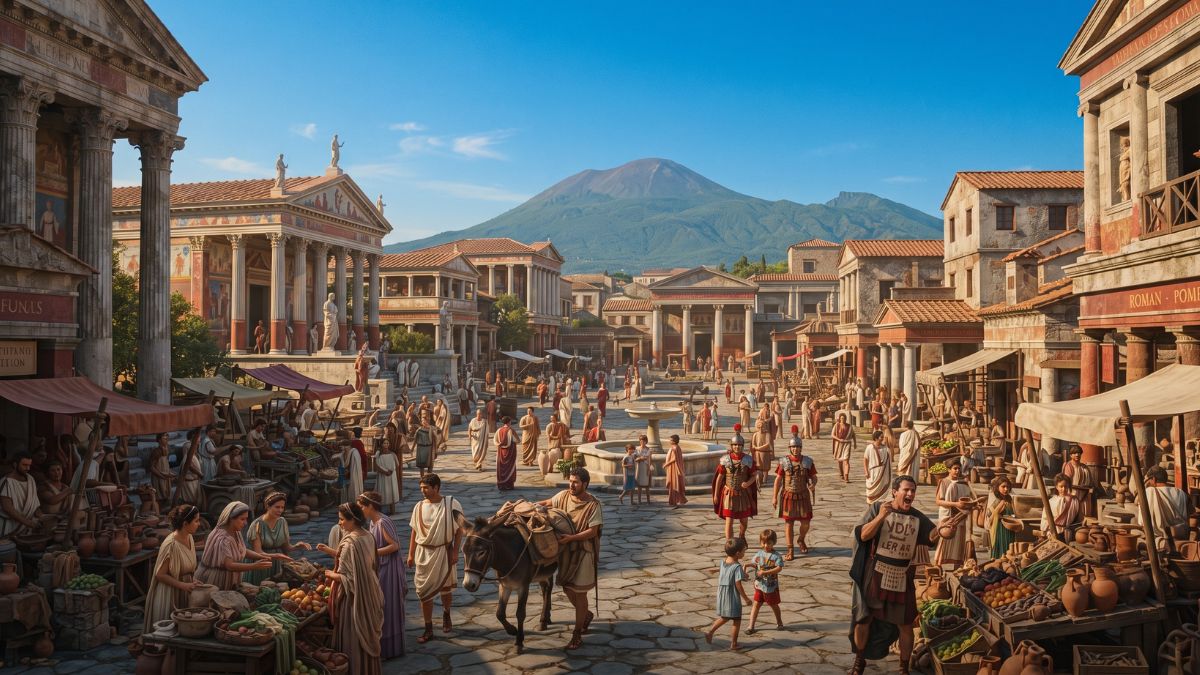
Discover why ancient eyewitnesses scrawled “Sodom and Gomorrah” on the walls of a buried Roman city. This deep dive explores the eerie timing of Mount Vesuvius’s eruption in 79 CE, the carnage of the Jewish-Roman War, and the tragic historical inspiration behind Chapter 31 of God’s Viceroys.
Exploring the ash-covered streets of Vesuvius reveals a stunning look at daily Roman life, but your journey through the empire is not complete without visiting the grand capital. Every road in the ancient world ultimately leads back to the monumental heart of power. Head over to our comprehensive Rome blogpost to discover the spectacular history, hidden traps, and must-see ruins of the eternal city.
The 79 CE Eruption: When the Sky Fell on Pompeii
We do not need to stand at the edge of Mount Vesuvius to feel the terrifying reality of volcanic annihilation. A vast ocean of modern materials—haunting photographs, archaeological articles, documentaries, and cinematic re-enactments—can instantly plunge our mood into deep sorrow. Looking closely at these remnants leaves us profoundly distraught.
We naturally sympathize with the innocent souls caught in this swift, apocalyptic disaster. These were ordinary people going about their routine daily business. Bakers were sliding loaves into the oven. Families were resting peacefully in their bedrooms. Even a poor, loyal guard dog was left chained to its post. One can barely imagine the sudden agony and confusion that helpless animal experienced. Every single resident remained completely oblivious to the impending doom building right beneath their feet.
A Modern Tour Through a Frozen World
To walk through the excavated ruins of Pompeii today is to step into a city frozen mid-breath. The preservation is so flawless that it feels as though a camera snapped a picture of a single first-century moment. Beneath the volcanic ash, the grand Roman architectures stand tall. Intact colonnades, grand amphitheaters, and sprawling aristocratic villas reveal the sheer scale of Roman engineering.
Pedestrians can still walk the stone streets. These roads feature high curbs and large, raised stepping stones. The stones allowed citizens to cross the street without stepping into the water and waste that filled the gutters.
Scratchings and political advertisements line the plaster walls of these ancient buildings. These vivid graffiti give us a direct window into the minds of the locals. Yet, nothing shakes visitors more than the haunting plaster casts of the victims. When the bodies decomposed over the centuries, they left perfect hollow cavities in the hardened ash. Archaeologists carefully poured plaster into these voids, capturing the exact, final expressions of terror, desperate embraces, and defensive postures.
Behind the Plaster: The Ancient “Sin City”
Behind the tragic pity of the ruins, history reveals that Pompeii did not hide its deep extravagance. The resort town operated as an ancient “sin city” for wealthy elites. Local artisans shamelessly painted highly explicit, erotic frescoes all over the place. These graphic scenes adorned public bathhouses, commercial brothels like the Lupanar, and ordinary residential houses.
To modern eyes, this lifestyle raises sharp questions: What were they thinking? Was this casual public display considered normal? Did the children of the household not see these graphic images every day?
In Roman society, the phallus was treated as a common symbol of good luck and a ward against the evil eye. It was etched into public walkways, stamped onto terracotta oil lamps, and hung outside shops. What we categorize today as taboo luxury was woven tightly into their daily cultural landscape.
The Apocalyptic Connection to Jerusalem
A zealous man or woman of faith might look at this shocking decadence and quickly judge the inhabitants. They might declare that the citizens simply reaped what they sowed. To strict religious observers, the rain of fire and sulfur on Vesuvius made the city a literal, later-day Sodom and Gomorrah.
Remarkably, an ancient survivor felt exactly the same way. Investigators picking through the ruins after the eruption discovered a piece of charcoal graffiti scrawled on a wall in Region IX. The faded Latin inscription reads: SODOM GOMOR.
The “Sodom and Gomorrah” charcoal graffiti remains one of the most provocative historical clues found in the ash, proving that someone at the site viewed the eruption as a direct act of divine wrath.
Could this catastrophic event have been a targeted punishment linked to the brutal Jewish-Roman War? Just nine years earlier, in 70 CE, the Roman legions carried out a horrific carnage in Judea. They destroyed the sacred Second Temple and leveled Jerusalem.
Coincidentally, the man who led that brutal siege was the young military commander Titus, son of Emperor Vespasian. By incredible historical irony, Titus had been inaugurated as the absolute Emperor of Rome just two short months before Mount Vesuvius erupted.
Divine Retribution and the Lost Messengers
For the surviving Jewish diaspora and early believers, the eruption looked like a clear cosmic warning. Rome had sanctioned the execution of two monumental messengers of God. The empire carried out these acts with the direct collaboration of corrupt local elites. Following those events, the state went on to fiercely persecute the early Nazarene movement.
The Romans targeted the early community led by James, the brother of Jesus, and eventually hunted the final Jewish holdouts to the cliffs of Masada. Because of Titus’s actions and the systemic corruption of the empire, many believed Pompeii was selected for absolute destruction.
From History to Fiction: The Viceroy of Pompeii
This rich blend of history and human drama is deeply tragic yet profoundly inspiring. It provides the exact conceptual foundation for Chapter 31 of my novel, God’s Viceroys (published in hardcover as The Viceroys of God).
The narrative draws on a core principle from the Quran: every nation is assigned a spiritual messenger to offer guidance. To drive this powerful point home, the chapter introduces a compelling fictional character who acts as a lone warner to the doomed city.
The story centers on Felix, an elite Roman equestrian. Before his calling, Felix served on the dangerous frontiers of the empire, battling fierce Germanic tribes in Batavia (modern-day Holland). As a strict Stoic and a principled deist, Felix consistently refused to claim defeated captives as slaves. This honorable stance deeply angered his plunder-hungry subordinates. Fearing an imminent mutiny, the commanding general—a close friend of Felix’s father—ordered him into early retirement and sent him back to Campania.
A Lonely Prophet in a Doomed Resort
Returning to his homeland, Felix chose to live quietly in a rustic Roman villa a short distance outside the bustling city walls of Pompeii. He had already emancipated his own household slaves. In deep gratitude, an appreciative mother offered her beautiful daughter to Felix as a companion. Though deeply tempted by the offer, his strict moral discipline led him to politely decline.
It was in this quiet isolation that an extraordinary event altered his life. A powerful entity, appearing as an angel of God, visited the retired soldier. The messenger revealed that Felix was officially appointed as a viceroy of God. His urgent mission was to warn the indulgent citizens of Pompeii to turn away from their corruption.
Felix initially hesitated, fearing that he was suffering from a vivid hallucination. However, the sheer weight of the spiritual presence quickly convinced him of the divine reality of his calling.
The Price of Truth
Filled with prophetic urgency, Felix marched into the crowded markets and public forums of Pompeii. He boldly warned the wealthy vacationers and local merchants of an impending, fiery doom unless they immediately repented.
Instead of heeding his words, the proud citizens mocked his message. They viewed him as a dangerous religious fanatic threatening their lucrative tourism and tranquil luxury. The public fury quickly escalated. The hostile crowd turned on Felix, brutally hanging and murdering the lonely warner.
By killing the messenger sent to save them, the city sealed its fate. Shortly after his martyrdom, the mountain fractured, the sky turned black, and Pompeii was wiped from the face of the earth.
Get your copy of the revised and expanded 2026 edition of God’s Viceroys by Don Peter today
Beyond the Ruins: Plan Your Journey
To fully appreciate the scale of this ancient tragedy, you should explore the incredible destinations surrounding the buried city. You can stand on the active summit of the volcano by reading our guide on Hiking Mount Vesuvius, or discover an intact Roman beach town frozen in mud through our feature on Exploring the Herculaneum Ruins.
If you want a taste of classic Italian luxury after the history, don’t miss our day trip itinerary covering The Clifftop Towns of the Amalfi Coast. In fact, this spectacular coastline is exactly where I visualized Felix’s rustic villa in my novel, God’s Viceroys. Come explore the paradise that inspired the pages!
Finally, you can view the actual original frescoes and explicit artwork removed from the ash by diving into our guide to The Historic Streets and Museums of Naples.
The Echoes of a Frozen Silence
Ultimately, Pompeii remains far more than an ancient archaeological marvel. It stands as a timeless monument to human vulnerability. The haunting plaster figures remind us how quickly a routine life can vanish. These souls collapsed in their final seconds of agony. They prove that material wealth cannot shield anyone from cosmic reality.
People can view this catastrophe as a simple geological misfortune. Alternatively, observers can see it as divine retribution for the blood spilled in Jerusalem. Regardless of your viewpoint, the core lesson remains entirely unaltered. Luxury frequently blinds a society to its deepest moral failings. Furthermore, communities often silence the lonely voices of truth. When this happens, the ground beneath our feet is never truly solid.
For shorter essays and lighter reflections on the creative writing journey, you can also easily follow my updates on MEDIUM.
The ruins of Pompeii continue to speak across the centuries. They actively urge us to listen before our own sky turns to ash.
Do you want to explore the deep historical research behind my novels? To connect with me directly, please subscribe to my SUBSTACK.