
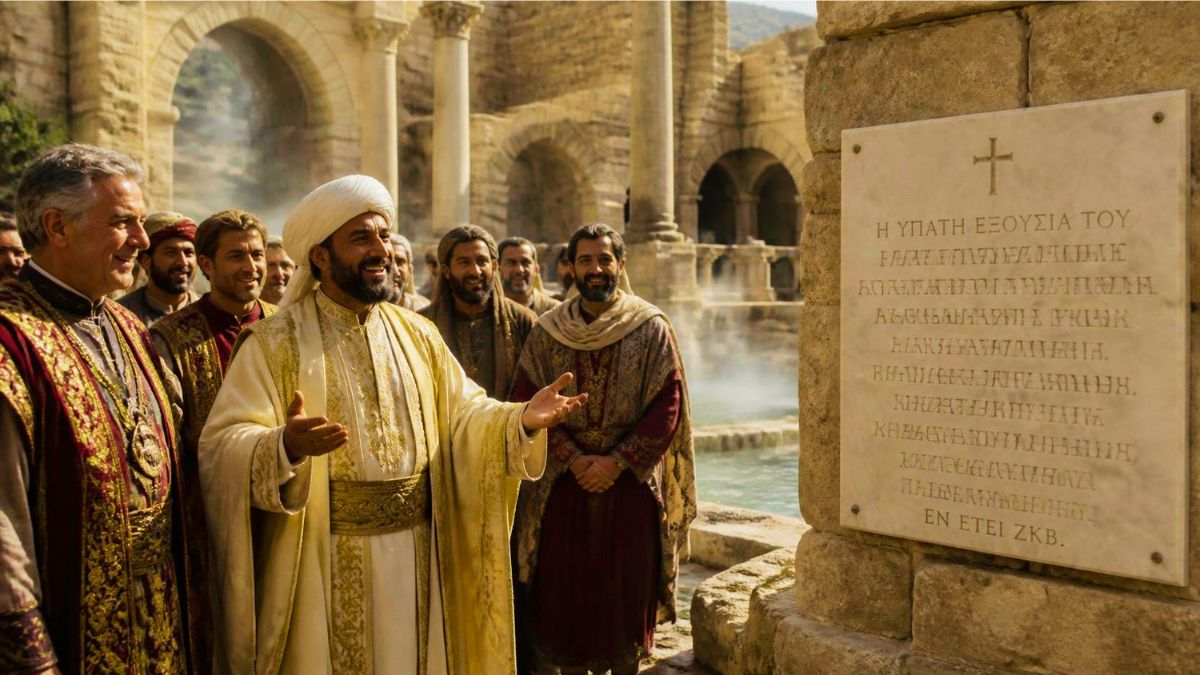
Discover how archaeological evidence challenges traditional views of the Umayyad Caliphate. This article explores Greek inscriptions, Arab-Byzantine coins, and bilingual papyri to reveal the early Mu’min movement—a fascinating history that inspired the historical thriller novel DOGMA.
How is Early Islam Viewed?
Most people hold a highly standardized view of early Islamic history. Traditional Muslims, modern religious scholars, and even many Western researchers share this common perspective. They believe that the Mu’min (Believer) movement was a fully formed, distinct religion from its very inception.
According to this conventional narrative, the community under Prophet Muhammad and the Rashidun Caliphs operated under a rigid system. They view this era as a society governed immediately by Islamic tradition and strict Sharia laws. This perspective assumes that the early conquests aimed primarily at converting the conquered subjects of the Near East.
Furthermore, conventional history views early Islamic society through three rigid social classes. The ruling elite consisted entirely of Muslims. Beneath them sat the dhimmis, who were protected non-Muslim monotheists. These subjects paid a special tax called the jizya to maintain their religious freedom. At the bottom of this structure were the slaves.
However, modern historical analysis reveals a major flaw in this rigid model. This classic three-tiered system does not actually reflect the reality of the 7th century. Instead, this view is a later historical product. It grew out of 9th-century Abbasid literary sources.
These later writers lived deep within the eastern territories of Persia and Central Asia. In those cultures, scholars frequently blended historical facts with theological myths and creative fiction. They projected their own highly developed religious environment backward onto the simpler times of the early conquests.
Consequently, this retrofitted history created a biased timeline. It painted the rule of Muhammad and the Rashidun Caliphate as a spiritually pure, democratic golden age. In stark contrast, it portrayed the subsequent Umayyad Caliphate as corrupt renegades.
Traditionalists still view the Umayyads as the most negative chapter in early Islamic history. They accuse them of secularizing a holy movement. Yet, contemporary archaeology tells a completely different story about who these rulers actually were.
A Brief History of the Umayyad Caliphate
The Umayyad Caliphate arose in 661 CE during a time of immense internal political chaos. It followed the assassination of Ali ibn Abi Talib, the fourth Rashidun Caliph. Mu’awiyah I, the savvy governor of Syria, seized the opportunity. He established the Umayyad dynasty and decisively moved the imperial capital from Medina to Damascus.
Under Umayyad leadership, the borders of the empire expanded at a breathtaking pace. Within a few decades, their territory stretched from the rugged borders of India all the way to the Atlantic coast of Spain.
Managing such an enormous empire required a massive administrative network. However, the Umayyads did not build a complex bureaucracy from scratch. They simply lacked the manpower and administrative experience to do so.
Instead, they adopted the existing, highly efficient state systems of the Roman Byzantine and Persian Sasanian empires. This pragmatic choice meant that Christian and Zoroastrian bureaucrats kept their imperial jobs.
These local officials continued to manage the vital tax ledgers. They ran the daily operations of the state just as they had done for centuries. This inclusive approach allowed the Umayyads to maintain stability across vast, culturally diverse territories.
Why Modern Muslim Scholars Disfavor the Umayyads
Despite their incredible political success, modern traditional Muslim scholars still view the Umayyads with deep skepticism. This widespread disapproval stems directly from a specific theological narrative. Critics believe that the Umayyads intentionally destroyed a perfect, Sharia-compliant system established by the Rashidun.
Religious commentators frequently accuse Mu’awiyah I of introducing a corrupt, secular kingship (mulk). They argue that he replaced a righteous, spiritually pure leadership with a worldly dynasty.
However, this harsh narrative relies almost entirely on histories written centuries later. The Abbasid Caliphate overthrew the Umayyads in 750 CE through a bloody revolution. To legitimize their new regime, Abbasid historians systematically painted their predecessors as godless tyrants.
They claimed the Umayyads cared far more for royal luxury than for divine law. This intense historical bias created the modern assumption that the Umayyads abandoned a fully formed Islamic legal framework. In truth, that framework did not even exist yet.
Continuity with the Early Mu’min Movement
Contemporary historical research reveals a completely different reality on the ground. The Umayyads did not abandon the original movement of Prophet Muhammad. In fact, they were much closer to the early Mu’min (Believer) movement than later Abbasid traditions care to admit.
During the mid-7th century, a rigid, exclusive “Islamic” identity simply did not exist. The conquering community did not call themselves Muslims in their earliest documents. Instead, they consistently used the term Mu’minun.
This early movement functioned as an inclusive, monotheistic confederation. It successfully united pagan Arab converts, righteous Jewish communities, and vast numbers of Christian Arabs. Monophysite Christian groups like the Ghassanids played crucial roles in this coalition.
These diverse groups did not share identical religious rituals or theological creeds. However, they shared a fierce belief in the One God, the coming Last Day, and the absolute duty to perform righteous deeds. The Umayyads simply continued this open community model throughout their rule.
The Turning Point: Abd al-Malik and the Marwanid Shift
Nevertheless, the Umayyads do share the historical responsibility for altering the trajectory of the faith. Following a brutal second civil war, Caliph Abd al-Malik ibn Marwan took power in 685 CE. He realized that a loose confederation could no longer hold the fractured empire together.
To unite his subjects, he transformed the open Mu’min movement into a strict, exclusive religious identity. He formally codified the term “Muslim” to separate his ruling class from the rest of the monotheistic world.
Abd al-Malik built the magnificent Dome of the Rock in Jerusalem to announce this new imperial identity. He covered its walls with specific, anti-Trinitarian inscriptions to draw a clear line between Islam and Christianity.
However, his version of Islam remained raw, political, and relatively uncomplicated. It still lacked the intricate theological and legal structures that defined later centuries. Only after the Abbasids took control did the faith morph into a highly complex global religion, heavily shaped by Persian cultural values.
Archaeological Evidence: The Hammat Gader Inscription
Physical artifacts offer undeniable proof of this early, multi-layered society. The Hammat Gader inscription stands as a prime example. This famous Greek marble slab was discovered at an ancient Roman hot springs resort near the Sea of Galilee. It dates precisely to 662–663 CE, during the early reign of Mu’awiyah I.
The text begins clearly with a Christian cross ($+$). It identifies the Caliph using the Greek transliteration of his Arabic title: amēra almoumenēn (Commander of the Faithful). Furthermore, a Christian magistrate named John supervised the entire construction project.
This inscription proves that the early Umayyad state openly embraced Christian imagery. They employed Christian leaders at the highest levels of government and used the Greek language for major public works.
Archaeological Evidence: Arab-Byzantine Coinage
Early Umayyad currency also shatters the myth of an immediate, total cultural break from the past. When the Arabs conquered the Levant, they did not create a brand-new monetary system. Instead, they minted what historians call Arab-Byzantine coins.
These copper and gold coins directly copied the currency already in circulation across the region. They prominently featured images of the Byzantine Emperor holding a Christian cross.
Umayyad minters initially made only minor adjustments to these designs. They sometimes clipped the horizontal bars off the crosses or stamped the Arabic phrase “Bismillah” onto the outer edges.
The Umayyads valued economic continuity over religious exclusion. They happily used these hybrid coins for decades. They only stopped when Abd al-Malik introduced pure, text-only Arabic coinage in 697 CE to assert his new, exclusive state identity.
Archaeological Evidence: The Administrative Papyri
Invaluable historical evidence also comes from caches of 7th-century papyri. Discovered in the desert regions of Nessana and Aphrodito, these documents serve as real-time financial records. They include tax demands and invoices issued by early Arab governors.
Because they were written for daily business rather than historical propaganda, they provide an unvarnished look at early Umayyad life.
The papyri are almost entirely bilingual. Scribes wrote them side-by-side in Greek and Arabic. They show that the Umayyads kept the old Byzantine tax apparatus fully intact.
Local Christian scribes managed the ledger books, recorded land values, and issued tax receipts to citizens. These documents reveal a highly pragmatic government. The state focused entirely on efficient administration rather than enforcing religious conformity.
Islamic Calendar & Dual-Calendar System Explained
The Umayyads eventually encountered a major financial crisis because of a fundamental conflict between faith and treasury management. The Islamic calendar is strictly lunar. A lunar year lasts only about 354 days. This makes it 11 days shorter than a standard solar year.
Consequently, the lunar months drift backward through the natural seasons over a predictable 33-year cycle. This drift created a logistical nightmare for agricultural tax collection, known as the Kharaj.
Wheat and barley harvests depend entirely on the sun, not the moon. If tax collectors demanded payments based solely on the shifting lunar calendar, they often arrived months before the crops were harvested. This left local farmers broke and the state treasury completely empty.
To solve this dilemma, the Umayyads created a brilliant dual-calendar system. They kept the Hijri lunar calendar for religious duties and state decrees. However, they adopted the Roman Julian solar calendar and the Byzantine Indiction cycle for financial administration.
Both the Hammat Gader inscription and the Nessana papyri clearly show these dual dates. By anchoring their financial year to the solar calendar, the Umayyads ensured that tax collection always matched the autumn harvest.
The Reality of Early Umayyad Rule
The physical evidence forces a major reconsideration of early Islamic history. The Greek inscriptions, hybrid coins, and bilingual papyri prove a vital point. The Umayyad Caliphate did not operate as an isolated, radically different religious state. They did not enforce a complex legal system across the region.
Instead, the Umayyads functioned as the direct guardians of an inclusive, evolving monotheistic movement. They utilized the existing languages, laws, and calendars of the conquered worlds to build a stable empire. Their story is one of cultural blending and political survival, which looks vastly different from the narratives created by later dynasties.
Connection to DOGMA
This rich, hidden history serves as the direct inspiration for the imagery and themes found in my novel, DOGMA: Untold History of Early Christianity & Islam. The book cover features a striking illustration of an Umayyad Caliph standing on his palace balcony, thoughtfully overlooking the grand Damascus Christian Basilica. This visual perfectly captures the blended, tolerant reality of the 7th-century Levant.
The story follows two inquisitive modern inventors who refuse to accept traditional historical narratives blindly. Seeking to discover the absolute truth about the origins of their faith, they develop a time-travel device and journey back to the era of the early Caliphate. What they uncover on the ground shatters everything they were ever taught in modern classrooms. DOGMA is a meticulously researched, historical investigation wrapped inside the fast-paced packaging of a religious thriller.
The Destiny of the Nazarene Movement
Meanwhile, the true legacy of the Nazarene movement did not vanish with the fall of Jerusalem. Instead, its revolutionary monotheistic vision quietly shifted into the desert sands, awaiting its final historical revival. To trace where these scattered believers fled next, read article, The Masada Mystery.

DOGMA by Don Peter — Click the cover to get your copy
The Journey Continues
The silent stones of the ancient world continue to speak across the millennia. They urge us to study their structural triumphs and failures before our own modern empires face a similar decline.
Want to stay connected with the research, stories, and ongoing debate?
 Join the Discussion on Substack
Since this pillar post doesn’t feature a comment box, Substack is the best place to share your thoughts, ask questions, and join the conversation directly with me.
 Follow the Creative Process on Medium
Read my regular historical insights, character sketches, and reflections on the creative writing journey.