
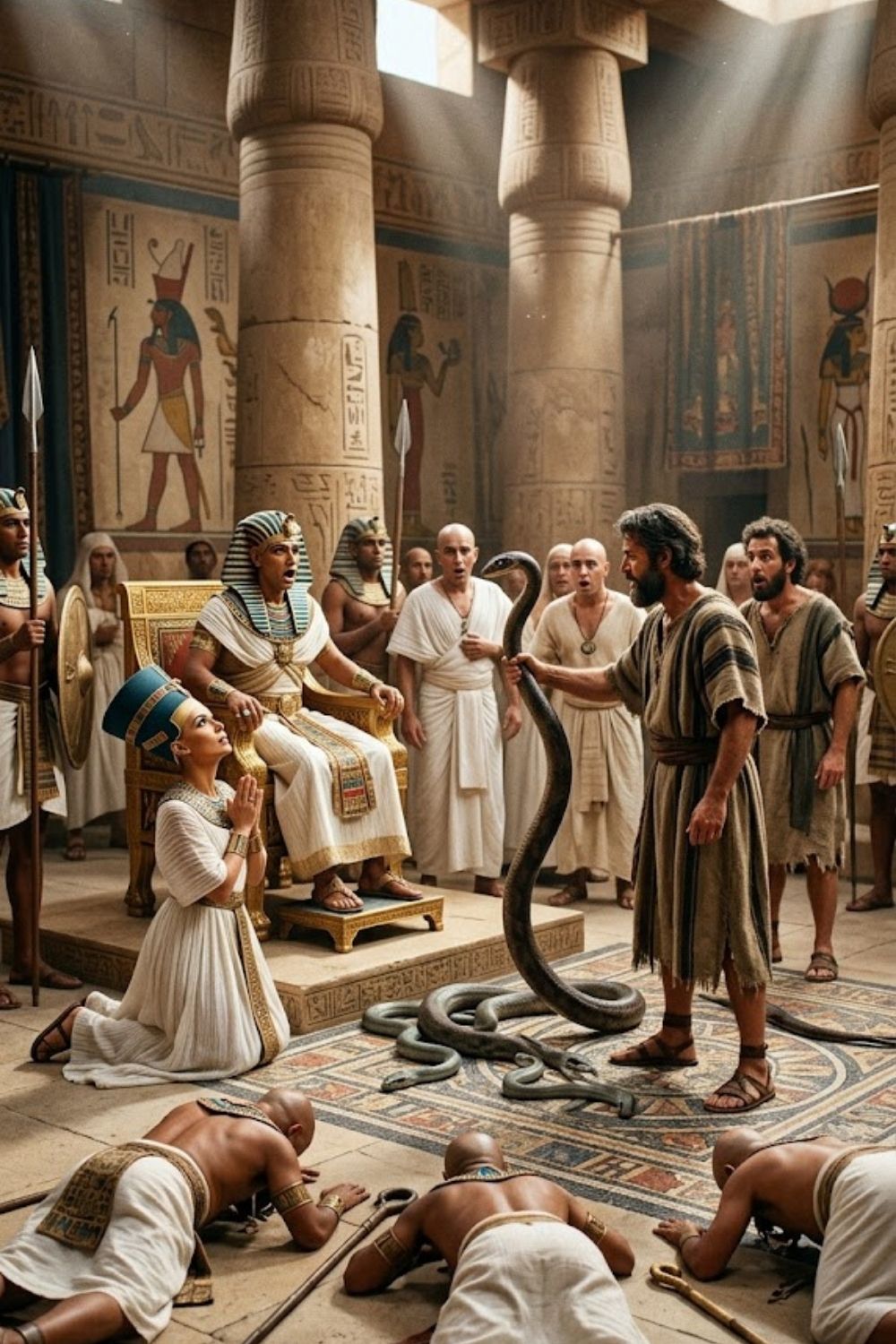
Who was the real Pharaoh of the Exodus? For centuries, scholars have debated if the eccentric Akhenaten was the man who challenged Moses. Discover the truth about the Pharaoh and Nefertiti. This historical analysis explores whether they were the rulers who witnessed Moses. We examine the rise of the Aten cult, the erasure of their names from history, and the dramatic confrontation between Moses and the magicians described in the Quran.
The Mystery of the Erased Queen
Nefertiti remains one of the most iconic yet mysterious figures of the ancient world. Her name means “a beautiful woman has come.” She reigned alongside her husband, Pharaoh Akhenaten, during the 18th Dynasty. However, after the 12th year of her husband’s reign, Nefertiti nearly vanished from the official historical record.
Scholars believe the Egyptians deliberately erased her image and name. This practice, known as damnatio memoriae, was reserved for those deemed heretics or enemies of the state. While some suggest she died of a plague, many historians believe she was scrubbed from history because of her role in the radical religious revolution of her time. She was not just a queen; she was a pillar of a new, controversial faith that shattered the foundations of Egyptian society.
The Pharaoh of the Exodus: The Scholarly Consensus
When people discuss the Pharaoh of the Exodus, the general consensus usually points elsewhere. Most biblical scholars and historians look toward the 19th Dynasty. Specifically, Ramses II (Ramses the Great) is the most common candidate for the Pharaoh who encountered Moses. This is largely due to the biblical mention of the city “Raamses” which the Israelites were forced to build.
Other scholars suggest his son, Merneptah, because of the “Merneptah Stele,” which contains the first extra-biblical mention of “Israel.” However, a fascinating alternative theory links the Exodus to the 18th Dynasty, specifically the “Amarna Period” ruled by Akhenaten.
Akhenaten: The Eccentric Pharaoh
Akhenaten was perhaps the most polarizing figure in Egyptian history. Before he changed his name, he was Amenhotep IV. He inherited a world of many gods, but he sought to destroy that world. He is often called the “Heretic Pharaoh” because he abolished the worship of Amun and the traditional pantheon.
The Amarna Letters and the Title of Pharaoh
Akhenaten is famous for the Amarna Letters, a cache of diplomatic correspondence with nations like the Hittites, Mittani, and Babylonians. Interestingly, while the term “Pharaoh” was used as a palace description earlier, it began to be used more formally as a title for the king himself around this era. Akhenaten used his power to centralize everything under his own image.
The Controversy of His “Monotheism”
Many historians mistakenly label Akhenaten as the first monotheist. However, his religion was quite different from the ethical monotheism of the Jews. Akhenaten did not want his subjects to worship a distant, invisible God. Instead, he declared that the Aten (the sun disk) was the only god, and he was the only one who could communicate with it.
Essentially, Akhenaten wanted his subjects to worship him as the “one true living god.” He was the bridge. If you didn’t worship Akhenaten, you couldn’t reach the Aten. This was a move of supreme ego rather than spiritual humility.
The Enslavement and the New Capital
Akhenaten’s most radical move was abandoning the traditional capital of Thebes. He built a brand-new city in the desert called Akhetaten (modern-day Amarna). To build a city from scratch in such a short time required massive amounts of forced labor.
Historical-religious perspectives suggest that the Israelite tribes, who were already in Egypt, were pressed into brutal service to build this “City of the Sun.” Because the Israelites refused to acknowledge Akhenaten as a living god, their treatment became increasingly harsh. They were monotheists who believed in the God of Abraham. Akhenaten’s demand for self-worship was a direct insult to their faith.
Moses and the Return from Midian
Moses had previously fled Egypt. He had killed an Egyptian taskmaster to defend an Israelite and lived in the wilderness of Sinai for years. According to the narrative, God summoned him from the burning bush to return to the House of Pharaoh—the very house where he had been raised.
Moses did not return to a familiar Egypt. He returned to a land gripped by Akhenaten’s religious fanaticism. When Moses entered the court, he did not just face a political leader. He faced a man who claimed to be the literal embodiment of the divine.
The Duel with the Magicians
Pharaoh refused to release the Children of Israel. He mocked the idea of a God higher than himself. To prove his divinity, Pharaoh summoned his elite “magicians” or witchdoctors. This led to a supernatural duel. The magicians threw down their staffs, and they appeared to become snakes through illusion and witchcraft.
However, Moses’ staff turned into a real serpent and swallowed the others. This was a direct strike against the Pharaoh’s power. The Quran captures this dramatic moment vividly.
“He [Pharaoh] said: ‘If thou hast come with a Sign, show it forth, if thou tellest the truth.’ Then [Moses] threw his rod, and behold! it was a serpent, plain (for all to see)!… The magicians said: ‘We believe in the Lord of the Worlds, the Lord of Moses and Aaron.'” (Quran 7:106–122)
Nefertiti’s Secret Faith?
In this interpretation, as the magicians fell in prostration, they weren’t the only ones moved. Some traditions and interpretations suggest that members of the royal household—including the Queen—were secretly moved by Moses’ message.
While the Quran mentions the “Wife of Pharaoh” as a believer, some researchers in the “historical thriller” genre, like those exploring the Amarna period, parallel this with Nefertiti.
“And Allah sets forth, as an example to those who believe the wife of Pharaoh: Behold she said: ‘O my Lord! Build for me, in nearness to Thee, a mansion in the Garden, and save me from Pharaoh and his doings, and save me from those that do wrong’” (Quran 66:11).
The Erasure and the Red Sea
The end of Akhenaten’s reign was chaotic. The theory suggests that after the plagues, Akhenaten chased the Israelites into the sea. The Quran states that Pharaoh did not die a “normal” death but was claimed by the water while trying to repent at the last second.
“We took the Children of Israel across the sea: Pharaoh and his hosts followed them in insolence and spite. At length, when overwhelmed with the flood, he said: ‘I believe that there is no god except Him Whom the Children of Israel believe in: I am of those who submit (to Allah).'” (Quran 10:90)
The Quran adds a chilling detail about his physical remains:
“This day shall We save thee in thy body, that thou mayest be a sign to those who come after thee! But verily, many among mankind are heedless of Our Signs!” (Quran 10:92)
Scholars often point to the remarkably preserved mummies of the 18th and 19th dynasties as a fulfillment of this “witnessing.”
The Aftermath: A City Abandoned
Shortly after Akhenaten’s death, the city of Amarna was completely abandoned. The people returned to Thebes. They smashed the statues of the sun god and returned to their polytheistic habits. Akhenaten was stricken from the “King Lists.” It was as if he never existed.
Archaeologists only rediscovered him in the 19th century. His erasure was so complete that he remained a ghost for thousands of years. This fits the profile of a king whose end was so shameful and whose religion was so hated that the nation chose to forget him.
God’s Viceroys: Uncovering the Key
This investigation into the House of Pharaoh is part of a larger, ongoing Critical Analysis of Ancient Faiths, where we unearth the hidden historical foundations of the world’s most influential religions.
In the novel God’s Viceroys, modern archaeologist Jason Bryden explores these exact connections. He seeks to find the historical “Key” that unites the core truths of the Christian faiths. By looking at the story of Moses through the lens of the Amarna period, Bryden uncovers how the struggle against a “false living god” shaped the destiny of the world.
The story of Moses is not just a Sunday school lesson. It is a high-stakes political and spiritual thriller. It involves the most powerful empire on earth and a queen who may have sacrificed her place in history for a higher truth. Whether Nefertiti was the one who witnessed Moses remains a point of debate, but the echoes of her era suggest a world on the brink of a divine revolution.