
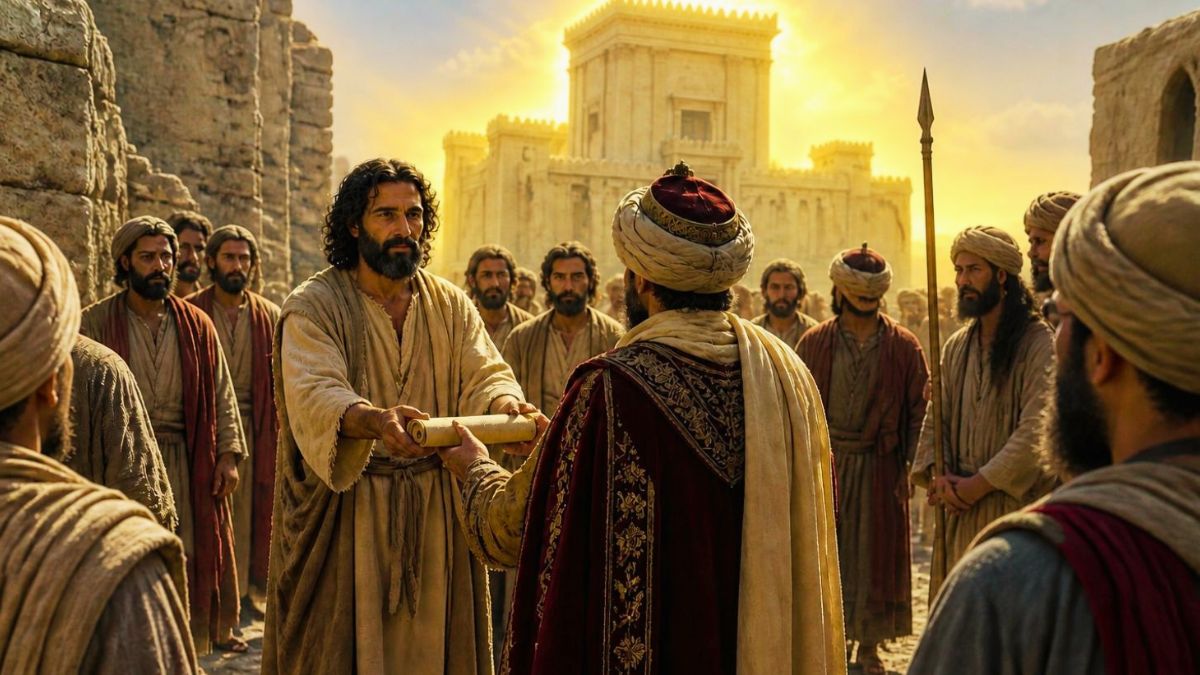
Did early Christianity conquer Rome, or did the empire absorb it? Discover how James the Just nearly established an earthly kingdom before internal fratricide ruined a divine geopolitical opportunity in 68 CE—a missed triumph successfully achieved six centuries later by Abu Bakr and the Mu’min Movement.
First Century Christianity
Ask any mainline Christian today about the history of their faith. Most devoted believers will confidently claim a complete victory.
Indeed, popular documentaries like PBS Frontline’s From Jesus to Christ echo this familiar narrative. They often describe how the name of Jesus ultimately brought down the mighty Roman Empire.
However, a deeper look at first-century history reveals a startling alternative. Did Christianity actually conquer Rome? Or did the Roman Empire simply absorb the religion to perpetuate its own global power?
Paul of Tarsus and the Roman Shift
To understand this historical pivot, we must first look at Paul of Tarsus. Originally a devoted Pharisee, Paul became a self-appointed apostle following a visionary conversion.
Crucially, he shifted the movement’s entire theological focus. Instead of preaching the original, grounded teachings of Christ, Paul heavily emphasized spiritual teachings about Jesus.
Consequently, this subtle pivot made the new faith highly attractive to a Gentile, Greco-Roman audience.
Paul effectively translated a localized Judean movement into a broader imperial religion. Therefore, he unknowingly laid the very first stones for Rome’s ideological takeover.
The Celestial Boardroom of the Church Fathers
Meanwhile, thousands of diverse writings circulated throughout the ancient Mediterranean world.
These documents included detailed historical accounts alongside deeply mystical Gnostic gospels. Because of this massive volume of texts, early church leaders faced a serious crisis of authority.
Furthermore, the Apostolic Fathers desperately needed a unified doctrine to maintain control.
They essentially formed a “celestial boardroom” to curate the official historical narrative. Ultimately, these leaders explicitly decided which books to accept and which to destroy.
They formalized these selective, politically driven choices at the Councils of Hippo (393 AD) and Carthage (397 AD).
Constantine, Nicaea, and the Final Merger
The final transformation eventually required supreme imperial authority.
Emperor Constantine quickly recognized the immense political utility of a unified, monotheistic religion. Therefore, he orchestrated the ultimate merger between Roman civilization and the growing Christian faith.
First, Constantine issued the Edict of Milan in 313 AD to fully legalize the religion. Next, he convened the famous Council of Nicaea in 325 AD.
By doing so, he officially standardized Christian theology under the watchful, controlling eye of the state. Ultimately, Christianity did not defeat the Roman Empire. Instead, the Roman Empire won the war by simply wearing a Christian mask.
The Forgotten Earthly Kingdom
To truly understand how Early Christianity almost won before Rome hijacked it, we must look backward. First, we must examine the fierce early struggles of Jesus and John the Baptist.
Crucially, these cousins intended to establish the Kingdom of God directly on earth. This was never meant to be a purely spiritual metaphor. According to John, God explicitly promised the Jewish nation absolute physical victory.
Consequently, John successfully mobilized the Galileans. Massive crowds of devoted followers flocked to the desert to be baptized. Meanwhile, as the younger cousin, Jesus operated primarily as his protégé.
Indeed, they represented the two prophesied Messiahs. Together, they planned to lead the sons of light to permanently defeat the sons of darkness.
The ancient world is a fascinating place to explore and immerse yourself in history. To see the actual landscapes where these monumental first-century events took place, click here to visit my Travel Page.
Rome Strikes First
However, the imperial government refused to wait for this rural uprising to fully bloom. With local collaborators on their side, Roman authorities swiftly assassinated John the Baptist.
Ultimately, this sudden execution left the movement completely paralyzed. Furthermore, a close reading of the Bible reveals that Jesus was deeply distraught by the loss.
He simply lacked the sheer charismatic gravity required to bring the Galilean masses back together. In fact, his own hometown crowd almost threw him over a cliff when he attempted a local rally.
The Jerusalem Campaign
To fulfill God’s ultimate command, Jesus boldly relocated his mission to Jerusalem. He genuinely hoped the highly educated Jewish elite would pragmatically accept his prophetic message.
Unfortunately, the exact opposite happened. The Jerusalem establishment firmly rejected him. Next, they betrayed him directly to Pontius Pilate, who subsequently ordered his execution.
Perhaps Jesus died on the Roman cross. Alternatively, maybe he escaped to the Spanish frontier with Mary Magdalene, or even fled to Kashmir. Regardless, we will leave those fascinating legends for another day.
James the Just Takes Command
Historically, we must rely on the Bible and the Roman historian Josephus for what happened next. Crucially, the torch of this early faith—then called the Nazarene Movement or “The Way”—passed to a new leader.
It fell directly into the hands of Jesus’s brother, James the Just.
Consequently, this sparked a brutal “do or die” period for the surviving followers. Much like Abu Bakr Al-Siddiq faced in the 7th-century Islamic world, the founding prophet was suddenly gone.
Therefore, the scattered congregation had to figure out how to force their mission to succeed. Suddenly, the window of opportunity burst wide open for the oppressed to finally make their move!
The Ultimate Divine Test
Ultimately, James the Just could have easily won the impending war against Rome. However, this total victory required the Jewish nation to willingly obey God and His messengers.
Indeed, this perfect geopolitical storm was a literal miracle at play. God was actively testing the Children of Israel. He clearly wanted to see if they could actually take advantage of this divine opening.
Rome in Flames: The Imperial Crisis
Meanwhile, historical events presented an unprecedented geopolitical opportunity. In 68 CE, Emperor Nero suddenly committed suicide. Consequently, he plunged the mighty Roman Empire into total chaos.
Three rival generals—Galba, Otho, and Vitellius—seized and lost power in rapid, bloody succession. Because the empire fought for its own sheer survival, Roman military operations in Judea completely froze.
Therefore, General Vespasian halted his advancing legions. This sudden pause left the imperial forces entirely paralyzed and highly vulnerable.
The Parthian Empire Distracted
Simultaneously, the rival Parthian Empire to the east offered no immediate threat. Although Parthia often challenged Rome, they suffered from their own internal turmoil during this exact period.
Specifically, King Vologases I faced brewing dynastic rebellions and severe nomadic threats on his northern borders. As a result, the Parthian armies remained too distracted to intervene in the Middle East.
Therefore, the geopolitical window for a successful Jewish uprising stood completely wide open from every direction.
Fratricide Behind Jerusalem’s Walls
Instead of seizing this miraculous moment to unite, the Jewish factions engaged in suicidal fratricide. Inside Jerusalem, radical rival warlords waged bitter, open war against each other.
Specifically, John of Giscala, Simon bar Giora, and Eleazar ben Simon slaughtered their own people. Furthermore, they senselessly burned their own multi-year grain supplies in pure mutual spite.
Tragically, the corrupt priestly aristocracy brutally murdered James the Just. Next, they systematically purged any remaining moderate voices from the city. As a result, the fragmented nation squandered its absolute greatest opportunity to break the Roman yoke.
The Alternate Timeline of the Mu’minun
Had the Jews actually rallied behind James and the Nazarenes, world history would have shifted dramatically. A unified Jewish Mu’minun (Believers’) movement could have easily routed the demoralized Roman legions.
Moreover, this united front could have easily checked the distracted Parthians. Consequently, this fierce early monotheistic empire might have swept westward toward the Maghreb.
Similarly, they could have pushed eastward deep into India. In effect, the global religious renaissance that eventually defined world history would have emerged six full centuries earlier.
The Striking Prophetic Parallel
Notice the striking parallel between these historical eras. Clearly, God’s hand actively guided both timelines. In the first century, John and Jesus brought the Good News of the arriving Kingdom of God.
Tragically, later authors mixed up and diluted that original message with competing texts. Six centuries later, Prophet Muhammad arrived with a final, unified revelation.
Specifically, the Quran explicitly promised the Mu’min (Believers) total victory. However, they first had to obey God and His Messenger completely.
Two Leaders, Two Different Fates
Leadership succession immediately tested both movements. James the Just took command after the first-century Messiahs departed. Six hundred years later, Abu Bakr al-Siddiq inherited leadership after Prophet Muhammad passed away.
James faced brutal internal struggles inside Jerusalem. Ultimately, these divisions led directly to the murder of Jesus’s disciples and James himself.
Conversely, Abu Bakr faced an identical crisis across Arabia. The fragile Muslim coalition almost disintegrated as rebel tribes violently resisted the message of God.
Abu Bakr and the Ridda Wars
Yet, a defining difference separated the two successors. Unlike the fractured leadership in Judea, Abu Bakr acted with absolute iron resolve.
He swiftly launched a decisive military campaign against the rebels. During the brutal Ridda Wars, he successfully crushed the tribal resistance.
Therefore, he firmly restored unity among the faithful. Instead of falling into suicidal fratricide, the sons of Ishmael forged an unbreakable brotherhood under one covenant.
Divine Timing or Geopolitical Luck?
Secular critics often dismiss the rapid rise of the early Mu’minun as mere geopolitical luck. They argue the believers simply exploited the mutual exhaustion of the Byzantine and Sassanian empires.
Yet, divine timing frequently moves through history’s open doors. Ironically, Abu Bakr faced the exact same Roman and Persian empires that James faced earlier.
Just like Rome and Parthia in 69 CE, the Byzantine and Sassanid superpowers stood completely exhausted. Decades of bloody conflict left them distracted and highly vulnerable.
The Kingdom Established
In both eras, the geopolitical window stood wide open. However, the outcomes diverged drastically based on internal choices.
Instead of seizing the moment together, rival Jewish factions turned their swords against each other. They foolishly squandered their divine opening, and their opportunity vanished into ashes.
Alternatively, the Rightly Guided Caliphs mobilized a united force. Subsequently, they shattered both the Byzantine Roman and Sassanid Persian armies. Thus, the early Caliphate triumphed to officially establish the sovereign Kingdom on Earth.
The startling historical parallels between Rome’s assimilation of the early church, the shattered hopes of James the Just, and the ultimate triumph of the early Caliphate form the factual foundation of my historical thriller, DOGMA. To see these exact first-century secrets brought to life and experience the raw, unfiltered history of the ancient Mediterranean firsthand, dive into the story below.
DOGMA by Don Peter
Two rival scientists—one Christian, one Muslim—use a groundbreaking neuro-synaptic simulator to project into the ancient past, each determined to prove the other’s faith wrong. But the unfiltered reality of history devastates both.
Want to dig deeper into the historical conspiracy?
Join me on Substack where we can interact, discuss the history, and build a community together.