
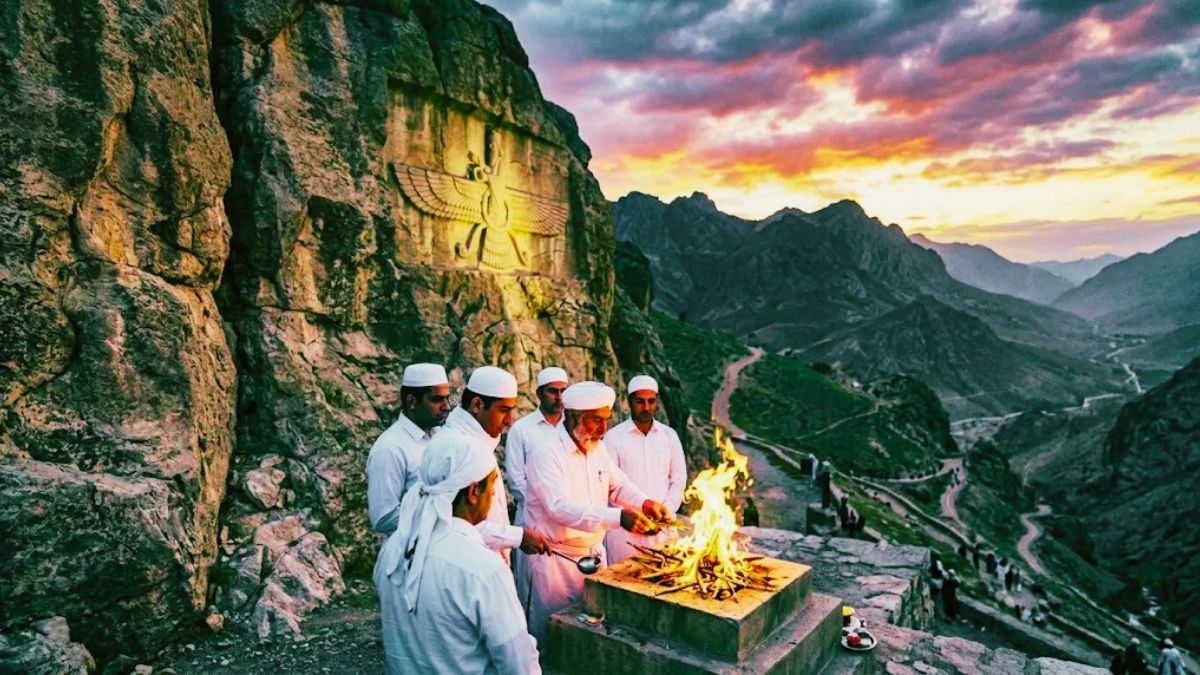
Did ancient Zoroastrianism truly disappear, or did it fundamentally evolve? While small Parsi communities still preserve sacred fire rituals today, the faith’s greatest legacy remains hidden in plain sight. Discover how exclusive Sasanian traditions, Persian administrative genius, and ancient rituals secretly engineered the foundational theology of modern orthodox Islam.
Zoroastrianism Today
Many people assume that Zoroastrianism vanished after the early Arab conquests. This is a significant historical misconception. While it is no longer a sprawling imperial faith, it survives as a resilient fringe religion.
Today, the global Zoroastrian population is small. Estimates place the number of adherents between 100,000 and 200,000 worldwide. They primarily live in two geographical pockets. These are Yazd and Kerman in Iran, and Mumbai and Gujarat in India. In the Indian context, they are famously known as the Parsis.
Modern Zoroastrianism has evolved significantly from its ancient form. However, two core traditions remain largely unchanged. First is their profound reverence for fire. Second is their unique and fascinating funeral practice.
Historically, Zoroastrians did not bury their dead in the earth. They also did not practice cremation. They believed that a corpse would pollute the sacred elements of soil and fire. To solve this, they built open-air stone structures called Towers of Silence (Dakhmas).
The deceased were placed atop these towers. Scavenger birds like vultures rapidly consumed the bodies. This left only clean, sun-bleached bones. While modern urban laws in India and Iran have forced many to adopt burial or cremation, the symbolic heart of the faith remains tied to these ancient roots.
Desert Conquerors Meet Imperial Bureaucrats
Arab tribes burst out of the desert in the 7th century. Consequently, they carried a message and a language of immense poetic beauty. They overwhelmed the Byzantines and the Sassanids with raw military genius. However, they arrived as fierce conquerors rather than meticulous grammarians.
To the Umayyad Caliphs, Arabic served as a natural inheritance. They spoke it fluently. They lived it daily. They breathed it constantly. Therefore, they possessed absolutely no reason to study it formally. Instead, they stayed busy ruling their new empire from Damascus.
Meanwhile, they delegated the messy work of daily administration to seasoned Byzantine Christian bureaucrats. These Roman officials already managed the local infrastructure efficiently.
The Abbasid Caliphate, however, operated entirely differently. Unlike their Umayyad predecessors, they aggressively rejected this Western reliance. Instead, they heavily favored native Persian administrators. They actively integrated highly educated Sasanian bureaucrats to govern their newly shifted eastern empire.
The Zoroastrian Roots of Cosmic Dualism
To understand this cultural synthesis, we must examine ancient Persian history. The prophet Zoroaster founded the original religion. Initially, he preached strict devotion to one supreme creator God. He called this divine entity Ahura Mazda, or the Lord of Wisdom.
According to this theology, Ahura Mazda remains locked in an eternal cosmic struggle. His dark opponent is Angra Mainyu, the Spirit of Destruction. Consequently, this binary view of the universe defines the entire faith. Good constantly battles evil. Light perpetually fights darkness.
Achaemenid Glory and Alexander the Great
Like early Islam, Zoroastrianism started as a simple, practical faith devoid of heavy rituals. Even when the Achaemenid Empire elevated it to imperial status, it remained relatively uncomplicated. Cyrus the Great founded this massive state. Darius later expanded its borders across the known world.
Furthermore, these Achaemenid kings left vast rock inscriptions across the mountainsides. They proudly claimed they ruled solely by the grace of Ahura Mazda. However, they did not yet enforce the rigid, suffocating dogmas and complex rituals that would define the later empires.
However, this golden age eventually fell to Alexander the Great. Yet, Alexander arrived not as a bitter nemesis, but as a profound admirer of Cyrus the Great. He deeply respected the Persian legacy and eagerly adopted their imperial customs. Nevertheless, the chaotic realities of conquest still disrupted the old religious order. Following his sudden death, the Hellenistic Seleucid Empire ruled the Iranian plateau.
Cultural Blending in the Hellenistic Era
This chaotic era sparked intense cultural blending. Zoroastrian concepts of cosmic dualism began to heavily influence surrounding regions. They introduced ideas of a final judgment. They popularized the concept of battling angels.
Consequently, these vivid ideas accelerated the evolution of intertestamental Judaism. Indeed, this specific period feels eerily similar to the apocalyptic texts found in the Dead Sea Scrolls. The scrolls famously depict a final bloody battle between the “sons of light” and the “sons of darkness.”
The ancient world is a fascinating place to explore and immerse yourself in history. To see the actual landscapes where these monumental first-century events took place, click here to visit my Travel Page.
Parthian Tolerance and Roman Mithraism
Eventually, the nomadic Parthian Empire drove out the Greeks. They maintained a highly tolerant version of Zoroastrianism. Furthermore, they allowed distinct regional cultures to thrive peacefully. Under Parthian rule, a specific offshoot of Persian culture spread rapidly westward. People called this mysterious movement Mithraism.
Mithraism centered intensely on Mithra. The Persians worshipped him as the god of light and unbreakable covenants. Subsequently, this secretive mystery cult spread rapidly deep into the Roman Empire. It became immensely popular among the hardened Roman military.
Roman soldiers deeply loved the cult’s strict emphasis on discipline. They respected its focus on unwavering loyalty. For a brief time, Mithraism acted as the primary religious competitor to early Christianity.
Furthermore, this profound Persian mysticism permeated the broader religious landscape. It can easily be said that the ideas of Gnosticism, which became highly prevalent by the end of the 1st century, drew heavily from these ancient Zoroastrian roots.
Sasanian Fundamentalism Sparks Brutal Wars
Finally, the Sasanian Empire overthrew the tolerant Parthians. They immediately established a highly centralized, fundamentalist Zoroastrian state. They aggressively turned the ancient faith into an official state church. Furthermore, they created a powerful, rigid hierarchy of Magi priests.
These Sasanian rulers aggressively persecuted foreign heretics. They codified the sacred Avesta texts into law. Consequently, this rigid stance set the stage for centuries of religious warfare. They fought relentlessly against the Christian Byzantine Romans.
The Byzantine-Sasanian Exhaustion
The Byzantine Roman and Sasanian Persian empires fought for several agonizing centuries. They locked themselves in a endless cycle of brutal, exhausting warfare. Territory constantly changed hands across the Levant. In the early 7th century, the Persians launched a massive, devastating invasion. They successfully captured both Damascus and Jerusalem.
However, the Byzantine Emperor Heraclius launched a desperate counter-offensive. He utterly defeated the sprawling Sasanian armies. Unfortunately, this pyrrhic victory left both great empires incredibly weak. They stood highly vulnerable to any new external threat.
The Early Mu’min Civil War
The early Mu’min movement arose directly in the shadow of this geopolitical exhaustion. Early historical analyses suggest the movement originally aligned with the Western, Greco-Roman world. The first Umayyad Caliphs felt highly sympathetic toward Byzantine culture. They eagerly absorbed Roman administrative systems into their new capital in Damascus.
However, a profound political fracture tore the Mu’min community apart. This disaster happened almost immediately after the death of the Prophet. The community violently split into two fiercely opposing factions.
Umayyads versus the Banu Hashim
The Umayyad clan represented a wealthy aristocratic faction. They strongly supported the rule of the first three Rashidun Caliphs. In contrast, the Banu Hashim faction comprised the direct family of the Prophet. Ali ibn Abi Talib, his cousin and son-in-law, led this passionate group.
A temporary truce initially allowed the unified armies to push outward. They rapidly conquered both the weakened Byzantines and the collapsing Sasanians. However, Mu’awiyah I aggressively challenged Ali for supreme leadership. Consequently, this bitter rivalry sparked the First Fitna. This brutal conflict became the first Mu’min civil war.
Relentless political maneuvering steadily weakened Ali’s position. An assassin tragically killed him shortly thereafter. Ultimately, this tragic death allowed Mu’awiyah to establish the hereditary Umayyad Dynasty in Damascus.
Umayyad Hellenization versus Hashimite Persianization
Following their decisive victory, the Umayyads ruthlessly hunted the remnants of the Banu Hashim. They actively targeted the loyalists of Ali’s family. To survive, the defeated Banu Hashim factions fled eastward. They entered the rugged, mountainous highlands of Iran.
They desperately sought refuge among the native Zoroastrian Persian population. These proud Persians deeply resented their distant Umayyad rulers in Damascus. Living in bitter exile, the Banu Hashim launched relentless guerilla campaigns against the Umayyad state.
Over several decades, a fascinating cultural synthesis occurred. The Umayyads in Damascus became thoroughly absorbed by Greco-Roman and Christian culture. Meanwhile, the exiled Banu Hashim became deeply embedded within Persian society. They lived alongside ancient Zoroastrian customs every single day.
The Philosophy of the Early Believers
The original Mu’min movement offered an uncomplicated, straightforward spiritual path. It rooted itself firmly in simple deism and practical stoicism. Its core mantra required a basic belief in the One God and the Last Day. Furthermore, it focused heavily on performing righteous deeds in the community.
However, the early movement lacked a highly developed philosophical structure. Consequently, its followers easily absorbed the traits of the ancient civilizations they inhabited. The Umayyads succumbed entirely to the Hellenistic West. In stark contrast, the Banu Hashim succumbed completely to the Farsi East.
The Abbasid Revolution Explodes from Khorasan
The Abbasids descended directly from Abbas ibn Abd al-Muttalib. He lived as an uncle to the Prophet. Therefore, this lineage made them a core branch of the Banu Hashim family. They brilliantly capitalized on decades of underground Persian resentment.
The Abbasids launched a massive, meticulously planned revolution in the mid-8th century. They operated primarily out of the eastern province of Khorasan. This specific region heavily supported a population of angry Persian-Arab converts.
In 750 CE, the Abbasid forces completely erased the Umayyad dynasty. They performed a series of brutal, highly coordinated massacres. Only one prominent Umayyad prince managed to escape the slaughter. Abd al-Rahman I fled across North Africa to Spain. There, he successfully established the independent Umayyad Emirate of Córdoba. Consequently, he ensured the unlikely survival of the western Umayyad line.
Baghdad Replaces Damascus
In the east, the victorious Abbasids moved the imperial capital away from Damascus. They built the glittering new imperial city of Baghdad. Notably, they positioned it right next to the old Sasanian Persian capital of Ctesiphon.
The Abbasids heavily favored the Persianized Banu Hashim factions. They also aggressively elevated the native Iranian elite to positions of extreme power. This strategic alliance created a powerful new class of Persian-Arabs. They spoke Arabic perfectly. However, they thought, ruled, and lived exactly like ancient Sasanian nobles.
Sibawayh Institutionalizes the Arabic Tongue
The greatest irony of Islamic history involves the formalization of the Arabic language. A Persian convert named Sibawayh first codified this “pure” tongue. He likely emerged from a traditional Zoroastrian background. While the Arab masters enjoyed their newfound splendors, Sibawayh looked at Arabic from the outside.
Specifically, he identified the complex triliteral root system. He meticulously mapped the intricate grammar that native Arabs simply took for granted. Ultimately, he did not just study the language. He institutionalized it forever.
The Persian Architects of the Golden Age
This massive Eastern shift completely re-engineered the theology of modern Islam. The scholars who collected the Hadith almost universally originated from Persia and Central Asia. Scholars like Bukhari, Muslim, Tirmidhi, and Abu Hanifa stood as direct products of this Persianized sphere. Ultimately, they permanently embedded complex Eastern values into mainstream Islamic thought.
If you analyze the names shaping Sunni and Shia identities, the Persian fingerprint appears everywhere. Abu Hanifa possessed Persian ancestry. He founded the massive Hanafi school of law. He prioritized logic and reason in jurisprudence. Imam Bukhari and Imam Muslim emerged from the Persian-speaking cities of Bukhara and Nishapur. They became the two most authoritative collectors of Hadith.
Imam al-Tirmidhi served as another giant of Hadith from the eastern city of Termez. Al-Tabari became the undisputed father of Islamic history. He hailed directly from the lush shores of the Caspian Sea. Finally, Imam Ghazali synthesized Sufism with orthodox law. He originated from the Persian city of Tus. He remains the most influential philosopher-theologian in history.
Ancient Rituals Reshape Modern Worship
This deep historical synthesis explains a major theological mystery. Modern Islamic rituals bear a striking, undeniable resemblance to ancient Sasanian Zoroastrian practices. Conversely, they look drastically different from early Judeo-Christian traditions in the Levant.
Consider the five daily prayers. Ancient Zoroastrian law required believers to pray exactly five times a day. They called these specific prayer periods Gahs (Sala). The priests timed these rituals precisely to the daily movements of the sun. They observed the Havan Gah (Fajr) from sunrise to noon. They prayed the Rapithwin Gah (Zuhur) at midday. They observed the Uzirin Gah (Asr) in the late afternoon. Furthermore, they prayed the Aiwisruthrem Gah (Magrib) at sunset and the Ushahin Gah (Isya) from midnight until dawn.
Notably, this exact ancient schedule matches the modern structure of the five daily Islamic prayers perfectly.
Ritual Ablution and the Spiritual Bridge
Furthermore, consider the practice of ritual ablution. Before executing each of these five prayers, a Zoroastrian had to perform Padyab. This requirement involved a strict ritual washing of the face, hands, and feet with clean water. They recited specific sacred verses during the cleansing process. The absolute similarity to the Islamic Wudu remains undeniable.
Additionally, Zoroastrians believed strongly in an afterlife trial. They taught that after death, all human souls must cross the Chinvat Bridge. This razor-sharp bridge spans directly over a fiery hell. The righteous souls cross safely into heaven. The wicked souls lose their balance and fall into the dark abyss. Consequently, this ancient concept perfectly mirrors the later Islamic theology of the As-Sirat bridge.
These intricate, highly structured rituals remained entirely absent from the simple monotheism of the early western Mu’min movement. Believers absorbed them directly during the transformative Abbasid era. Thus, Persian court customs steadily morphed into the absolute bedrock of orthodox religious practice.
The House of Wisdom and Persian Bureaucracy
As the Abbasid Caliphate grew, it rapidly became the center of world knowledge. The “House of Wisdom” in Baghdad famously translated countless Greek texts. However, the underlying Persian influence proved just as strong.
The Abbasid bureaucracy modeled itself directly on the ancient Sasanian administrative system. The powerful role of the Vizier, or chief minister, originated as a purely Persian concept. Even the elaborate court etiquette mirrored the awe-inspiring grandeur of the old Persian kings. Therefore, this shift represented more than a mere change in politics. It represented a fundamental change in the very soul of the religious movement.
Transforming Oral Tradition into Rigid Law
The incoming Persian scholars brought a deep cultural love for categorization and codified law. They aggressively took the fluid, open-ended oral traditions of the early Believers. Subsequently, they hammered them into a rigid, inflexible legal code. Scholars universally recognize this immense legal process as Jurisprudence, or Fiqh.
The four main schools of law in Sunni Islam absorbed heavy influence from this structured environment. For instance, Abu Hanifa utilized a highly rationalist approach to law. His structured methodology closely mirrored the complex legal systems of ancient Persia.
The Hidden History of Khorasan
The rugged province of Khorasan played a pivotal role in this massive transformation. It acted as the ultimate cultural melting pot for Arab and Persian identities. The Arab soldiers who originally settled there eagerly married into local Persian families. Within just two short generations, their descendants felt more Persian than Arab.
They adopted the melodic Persian language for daily life. They adopted advanced Persian agricultural techniques to farm the land. Most importantly, they adopted the fundamental Persian view of imperial leadership. To these citizens, a leader represented more than just an elected tribal chief. A true leader represented a divinely appointed figure.
The Shadow of God on Earth
This specific concept of “divine right” remains purely Sasanian in origin. Nevertheless, it rapidly found its way into the Abbasid concept of the Caliphate. The ruling Caliph literally became “The Shadow of God on Earth.” Consequently, this grand, imperial title stood as a far cry from the humble, accessible leaders of the early community in Medina.
Persian Philosophy Reshapes Mysticism
The great cultural synthesis did not stop at law and ritual alone. It also profoundly shaped Islamic philosophy and mysticism. Historians note that many early Sufis possessed Persian heritage. They naturally brought with them the ancient Persian focus on cosmic light and creeping darkness.
The esoteric concept of Ishraq, or Illumination, possesses deep, undeniable roots in Zoroastrian thought. It boldly suggests that true knowledge radiates exclusively from a divine light. Later Persian philosophers like Suhrawardi beautifully perfected this illuminating idea.
Architectural Shifts from Arches to Iwans
Even the monumental architecture of the era changed drastically. The earlier Umayyad mosques utilized classic Roman arches and Byzantine mosaics. The Dome of the Rock stands as a perfect example.
In contrast, the later Abbasid mosques utilized massive, towering arched entrances called Iwans. These structures served as a signature feature of Sasanian royal palaces. When you look at the breathtaking Great Mosque of Samarra, you are literally looking at ancient Persian engineering.
The Living Legacy of Modern Zoroastrians
Many people incorrectly assume that Zoroastrianism vanished entirely after the early Arab conquests. This assumption represents a significant historical misconception. While it no longer functions as a sprawling imperial faith, it proudly survives as a highly resilient religion.
However, what most accounts fail to consider are the vast number of people living on Earth today who, entirely unconsciously, continue to carry on this ancient culture and mysticism.
Millions of devotees still practice the Pandyap and Gah, observing these ancient rites of ritual purification and designated daily prayer times with extreme dedication. In fact, this deeply ingrained heritage is carried forward with such fiery devotion that it can even lead to violent confrontation if others were to question the nature or validity of their rituals.
Though they may not carry the name, billions of souls across the globe daily practice and live out the mystical and ethical legacy of Zarathustra—proving that while the empire may have fallen, its sacred fire was never truly extinguished.
This astonishing historical crossover forms the intellectual foundation of my novel. I titled it DOGMA: Untold History of Early Christianity & Islam.
In this gripping, fast-paced thriller, I explore these deep historical links directly. I frame the narrative through the sharp eyes of two brilliant modern scientists. Together, they build a revolutionary Virtual Reality Simulator. This incredible machine allows them to travel back in time. They accomplish this through highly vivid, biologically synchronized dreams.
DOGMA by Don Peter
Two rival scientists—one Christian, one Muslim—use a groundbreaking neuro-synaptic simulator to project into the ancient past, each determined to prove the other’s faith wrong. But the unfiltered reality of history devastates both.
Want to dig deeper into the historical conspiracy?
Join me on Substack where we can interact, discuss the history, and build a community together.