
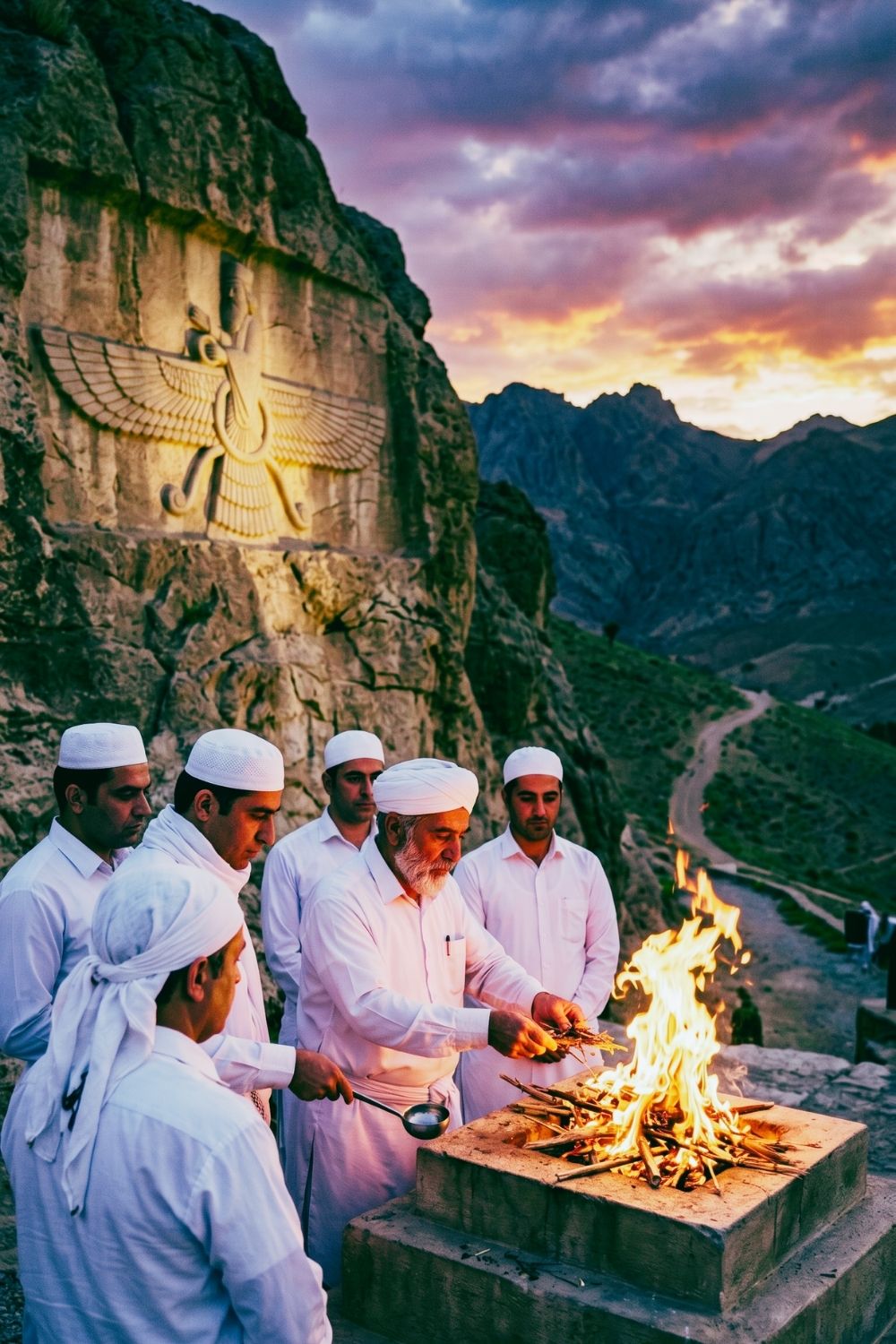
Explore the profound historical links between ancient Zoroastrianism, the early Mu’min movement, and the rise of the Abbasid Caliphate. Discover how Persian rituals and culture deeply shaped modern Islamic theology, and see how these hidden non-fiction historical facts form the core of the gripping time-travel thriller novel DOGMA.
Zoroastrianism Today
Many people assume that Zoroastrianism vanished after the early Arab conquests. This is a significant historical misconception. While it is no longer a sprawling imperial faith, it survives as a resilient fringe religion.
Today, the global Zoroastrian population is small. Estimates place the number of adherents between 100,000 and 200,000 worldwide. They primarily live in two geographical pockets. These are Yazd and Kerman in Iran, and Mumbai and Gujarat in India. In the Indian context, they are famously known as the Parsis.
Modern Zoroastrianism has evolved significantly from its ancient form. However, two core traditions remain largely unchanged. First is their profound reverence for fire. Second is their unique and fascinating funeral practice.
Historically, Zoroastrians did not bury their dead in the earth. They also did not practice cremation. They believed that a corpse would pollute the sacred elements of soil and fire. To solve this, they built open-air stone structures called Towers of Silence (Dakhmas).
The deceased were placed atop these towers. Scavenger birds like vultures rapidly consumed the bodies. This left only clean, sun-bleached bones. While modern urban laws in India and Iran have forced many to adopt burial or cremation, the symbolic heart of the faith remains tied to these ancient roots.
From the Achaemenids to the Sasanian Empire
The history of Zoroastrianism follows the rise and fall of Persia’s greatest empires. The prophet Zoroaster (Zarathustra) founded the religion. He preached devotion to one supreme creator God. He called this God Ahura Mazda, or the Lord of Wisdom.
Ahura Mazda is locked in an eternal cosmic struggle. His opponent is Angra Mainyu, the Spirit of Destruction. This binary view of the universe defines the faith.
The Achaemenid
This empire elevated the Zoroastrian faith to imperial status. Founded by Cyrus the Great and expanded by Darius, the empire spread these ideas across the known world. Achaemenid kings left vast rock inscriptions. They claimed they ruled solely by the grace of Ahura Mazda.
This golden age shattered when Alexander the Great conquered Persia. He burned the capital of Persepolis and scattered the priests. Following his death, the Hellenistic Seleucid Empire ruled the Iranian plateau.
This era saw intense cultural blending. Zoroastrian concepts of cosmic dualism, a final judgment, and angels began to influence others. These ideas accelerated the evolution of intertestamental Judaism. This period feels eerily similar to the battle between the “sons of light” and the “sons of darkness” in the Dead Sea Scrolls.
The Parthian
The nomadic Parthian Empire eventually drove out the Greeks. They maintained a tolerant version of Zoroastrianism. They allowed regional cultures to thrive. Under Parthian rule, a specific offshoot of Persian culture known as Mithraism spread westward.
Mithraism centered on Mithra, the Persian god of light and covenants. This secretive mystery cult spread rapidly into the Roman Empire. It became immensely popular among the Roman military. Roman soldiers loved the cult’s emphasis on discipline and loyalty. For a time, Mithraism was the primary competitor to early Christianity.
The Sassanid
Finally, the Sasanian Empire overthrew the Parthians. They established a highly centralized, fundamentalist Zoroastrian state. They turned the faith into an official state church. They created a powerful hierarchy of Magi (priests). They aggressively persecuted heretics and codified the Avesta. This set the stage for centuries of religious warfare against the Christian Byzantine Romans.
Byzantine-Sassanid Struggle and the Early Muslim Civil War
The Byzantine Roman and Sasanian Persian empires fought for centuries. They were locked in a cycle of brutal, exhausting warfare. Territory constantly changed hands. In the early 7th century, the Persians launched a massive invasion. They captured Damascus and Jerusalem.
However, during the lifetime of Prophet Muhammad, the Byzantine Emperor Heraclius launched a counter-offensive. He utterly defeated the Sasanian armies. This left both empires weak and vulnerable.
The early Mu’min (Believers) movement arose in the shadow of this conflict. Early analyses suggest the movement was originally aligned with the Western, Greco-Roman world. The first Umayyad Caliphs were highly sympathetic toward Byzantine culture. They absorbed Roman administrative systems into their new capital in Damascus.
However, a profound political fracture tore the Mu’min community apart. This happened almost immediately after the death of Muhammad. The community split into two fiercely opposing factions:
The Umayyad Clan:
This wealthy aristocratic faction supported the rule of the first three Rashidun Caliphs (Abu Bakr, Umar, and Uthman).
The Banu Hashim:
This faction comprised the direct family of Muhammad, led by his cousin and son-in-law, Ali ibn Abi Talib.
A temporary truce allowed the armies to push outward. They conquered both the weakened Byzantines and the collapsing Sasanians. However, when Ali finally took over the caliphate, Mu’awiyah I challenged him. This sparked the First Fitna, or the first Mu’min civil war.
Ali’s position weakened through political maneuvering. An assassin killed him shortly thereafter. This allowed Mu’awiyah to establish the hereditary Umayyad Dynasty in Damascus.
The Persianization of the Banu Hashim
Following their victory, the Umayyads ruthlessly hunted the remnants of the Banu Hashim. They targeted the loyalists of Ali’s family. To survive, the defeated Banu Hashim factions fled eastward. They entered the rugged highlands of Iran.
They sought refuge among the native Zoroastrian Persian population. These Persians deeply resented their distant Umayyad rulers in Damascus. Living in exile, the Banu Hashim launched guerilla campaigns against the Umayyad state.
Over several decades, a fascinating cultural synthesis occurred. The Umayyads in Damascus became thoroughly absorbed by Greco-Roman and Christian culture. Meanwhile, the exiled Banu Hashim became deeply embedded within Persian society. They lived alongside Zoroastrian customs every day.
The original Mu’min movement was an uncomplicated, straightforward spiritual path. It was rooted in deism and practical stoicism. Its core mantra required a simple belief in the One God and the Last Day. It focused on performing righteous deeds.
However, the movement lacked a highly developed philosophical structure. Consequently, its followers were easily reshaped by the ancient civilizations they inhabited. The Umayyads succumbed to the Hellenistic West. The Banu Hashim succumbed to the Farsi East.
The Rise of the Abbasid Caliphate
The Abbasids were descendants of Abbas ibn Abd al-Muttalib. He was an uncle of Muhammad. This made them a core branch of the Banu Hashim family. They capitalized on decades of underground resentment.
The Abbasids launched a massive, meticulously planned revolution in the mid-8th century. They operated primarily out of Khorasan. This region was heavily populated by Persian-Arab converts.
In 750 CE, the Abbasids completely erased the Umayyad dynasty. They performed a series of brutal massacres. Only one prominent Umayyad prince, Abd al-Rahman I, managed to escape. He fled across North Africa to Spain. There, he established the independent Umayyad Emirate of Córdoba. This ensured the survival of the western Umayyad line.
In the east, the victorious Abbasids moved the capital away from Damascus. they built the new imperial city of Baghdad. It sat right next to the old Sasanian Persian capital of Ctesiphon.
The Abbasids heavily favored the Persianized Banu Hashim factions. They also elevated the native Iranian elite. This alliance created a powerful class of Persian-Arabs. They spoke Arabic, but they thought, ruled, and lived like Sasanian nobles.
This Eastern shift completely re-engineered the theology of modern Islam. Most of the scholars who collected the Hadith came from Persia and Central Asia. Scholars like Bukhari, Muslim, Tirmidhi, and Abu Hanifa were products of this Persianized sphere. They permanently embedded Eastern values into mainstream Islamic thought.
Striking Structural Similarities in Zoroastrian Ritual
This deep historical synthesis explains a major mystery. Modern Islamic rituals bear a striking resemblance to ancient Sasanian Zoroastrian practices. They look very different from early Judeo-Christian traditions.
The Five Daily Prayers
Ancient Zoroastrians were required to pray exactly five times a day. They called these prayers Gahs. These were timed precisely to the movements of the sun. This matches the modern structure of the five daily Islamic prayers.
Ritual Ablution
Before each of these five prayers, a Zoroastrian had to perform Padyab. This was a strict ritual washing of the face, hands, and feet with water. They recited sacred verses during the process. The similarity to the Islamic Wudu is undeniable.
The Spiritual Bridge
Zoroastrians believed that after death, all souls must cross the Chinvat Bridge. This razor-sharp bridge spans over hell. The righteous cross safely into heaven. The wicked fall into the abyss. This concept perfectly mirrors the later Islamic theology of the As-Sirat bridge.
These intricate rituals were entirely absent from the simple monotheism of the early western Mu’min movement. They were directly absorbed during the Abbasid era. Persian court customs morphed into the bedrock of orthodox practice.
The Golden Age under the Abbasid Era
As the Abbasid Caliphate grew, it became the center of world knowledge. The “House of Wisdom” in Baghdad is famous for translating Greek texts. However, the Persian influence was just as strong.
The Abbasid bureaucracy was modeled on the Sasanian system. The Vizier, or chief minister, was a Persian concept. Even the court etiquette mirrored the grandeur of the Persian kings. This was not just a change in politics. It was a change in the soul of the movement.
The Persian scholars brought a love for categorization and law. They took the fluid oral traditions of the early Believers and turned them into a rigid legal code. This process is known as Jurisprudence (Fiqh).
The four main schools of law in Sunni Islam were heavily influenced by this environment. For example, Abu Hanifa, the founder of the Hanafi school, was of Persian descent. His approach to law was rationalist and structured, much like the legal systems of ancient Persia.
The Hidden History of Khorasan
Khorasan played a pivotal role in this transformation. It acted as the melting pot for Arab and Persian identities. The Arabs who settled there married into local Persian families. Within two generations, they were more Persian than Arab.
They adopted the Persian language for daily life. They adopted Persian agricultural techniques. Most importantly, they adopted the Persian view of leadership. To them, a leader was not just a tribal chief. A leader was a divinely appointed figure.
This concept of “divine right” is purely Sasanian. It found its way into the Abbasid concept of the Caliphate. The Caliph became “The Shadow of God on Earth.” This was a far cry from the humble leaders of the early community in Medina.
The Impact on Philosophy and Mysticism
The synthesis did not stop at law and ritual. It also shaped Islamic philosophy and mysticism (Sufism). Many early Sufis were Persians. They brought with them the ancient Persian focus on light and darkness.
The concept of Ishraq, or Illumination, has deep roots in Zoroastrian thought. It suggests that knowledge comes from a divine light. This idea was later perfected by Persian philosophers like Suhrawardi.
Even the architecture of the era changed. The Umayyad mosques, like the Dome of the Rock, used Roman arches and mosaics. The Abbasid mosques used the large, arched entrances called Iwans. These were a signature of Sasanian palaces. When you look at the Great Mosque of Samarra, you are looking at Persian engineering.
Zoroastrianism: Alive and Kicking!
Readers can verify this for themselves. Is this ancient religion truly extinct? Or did it simply evolve?
The evidence suggests the latter. The religion of the Achaemenids, Parthians, and Sasanians did not vanish. It deeply embedded itself into the established religions of today. It lives on in the five daily prayers. It lives on in the ritual of washing before prayer. It lives on in the belief in a bridge over hell.
When you look at the world today, the fingerprints of ancient Persia are everywhere. From the concept of “Satan” as a dualistic opponent of God to the very structure of religious law, Zoroaster’s legacy remains.
The Core of the Novel: DOGMA
This astonishing historical crossover forms the intellectual foundation of my novel, DOGMA: Untold History of Early Christianity & Islam.
In this gripping thriller, I explore these links through the eyes of two modern scientists. They build a revolutionary Virtual Reality Simulator (VRS). This machine allows them to travel back in time. They do this through highly vivid, biologically synchronized dreams.
Their mission is to investigate the true origins of their respective faiths. They want to see the truth behind the traditions. They want to witness the moment the simple became complex.
As they wander through the ancient streets of Damascus and Baghdad, they see it all. They watch the simple, open-ended monotheism of the early Believers collide with empires. They see the heavy bureaucratic weight of Rome and Persia reshape the message.
They witness the Umayyad court in all its Byzantine glory. Then, they see the Abbasid revolution turn the world toward the East. They see the priests and scholars codifying laws that would last for over a thousand years.
A Narrative Built on Fact
Although DOGMA is a fast-paced work of fiction, it is grounded in reality. Every single line of the narrative is built upon rigorous research. I have used verifiable, non-fiction archaeological and historical facts.
I want to reason with my readers. I want you to step out of comfortable, centuries-old traditions. I want you to look directly at the raw evidence. Our shared past is more connected than we are taught.
The “clash of civilizations” is often just a misunderstanding of a shared history. In DOGMA, I peel back the layers of time to show how the East and West were once one.
The thriller elements—the time travel, the secret societies, and the high-stakes science—are the vessel. The historical truth is the cargo. By the end of the book, you will never look at religion the same way again.
You will see the Towers of Silence in the architecture of modern cities. You will hear the echoes of the Avesta in the calls to prayer. Most importantly, you will understand how the hidden history of Persia shaped the world we live in today.
The story of DOGMA is not just about the past. It is about how the past creates the present. It is about the “Dogma” that we accept without question. It is time to start asking questions. It is time to discover the untold history.
Want to dive deeper into the history? I take the conversation further, address issues, and engage in detailed historical discussions exclusively with my community on SUBSTACK