
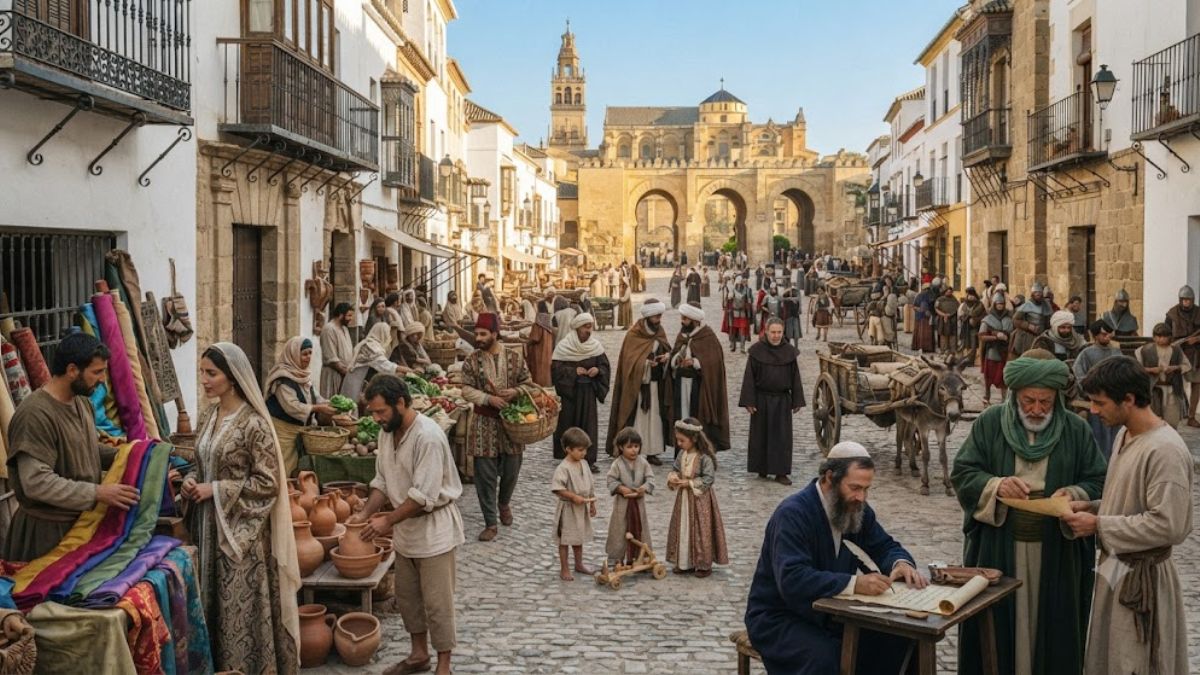
Explore the hidden history of Spain, from Roman conflicts to the legendary Mu’min movement. Discover how classical philosophy and the brilliant minds of Al-Andalus survived geopolitical purges, preserved ancient Greco-Roman wisdom, and ultimately ignited the European Renaissance. Read the final verdict on this lost civilization.
Exploring Spain’s historic fortresses, lost cities, and ancient landscapes reveals a fascinating legacy. From iconic monuments like Córdoba’s grand Mezquita and Granada’s Albaicín lookouts to Medina Azahara’s Caliphate ruins and Málaga’s Alcazaba fortress, each destination tells a story. Plan your next adventure with our historical guides to Seville’s Royal Alcázar, Ronda’s dramatic bridges, Catalonia’s coastal Tamarit Castle, day trips to Gibraltar, and Island routes through Gran Canaria and Tenerife’s Pyramids of Güímar.
Hollywood Myths and the Legend of El Cid
I recalled the dramatic climax of the 1961 cinematic classic El Cid. Directed by Anthony Mann and starring Charlton Heston alongside Sophia Loren, the film delivers an unforgettable, haunting finale. The soldiers strap the dead hero to his horse, Babieca, to terrify the Moorish forces.
Consequently, this clever psychological trick wins the battle for Valencia. However, this spectacular victory did not immediately cause the entire Muslim Empire in Spain to fall. In reality, the fall of Córdoba occurred much later due to deep internal conflicts and major ideological shifts rather than a single theatrical cavalry charge.
The Iberian Melting Pot of the Roman Empire
Centuries before the medieval knights, Rome conquered the Iberian Peninsula by defeating the dominant Carthaginians during the historic Punic Wars. This massive territory, known as Hispania, quickly transformed into Rome’s ultimate cultural melting pot.
Local Iberian tribes, Celtic settlers, Phoenicians, and Roman citizens merged into a uniquely vibrant society. They built sprawling aqueducts, massive theaters, and robust trade networks that connected the Atlantic to the Mediterranean.
This rich, militarized environment inspired the fictional hero Maximus Decimus Meridius in the 2000 film Gladiator. Hollywood accurately noted his roots, as the characters frequently call him “The Spaniard.”
How Spain Shaped the Imperial Roman Throne
In real life, the Spanish province yielded massive political and military power within the Roman Empire, noting the chaotic rise of Galba. While Galba claimed Italian birth, he famously governed the province of Hispania Tarraconensis for eight years. He used this strategic Spanish power base to march on Rome and briefly seize the throne after Emperor Nero committed suicide.
Furthermore, Spain swimmingly produced some of Rome’s greatest rulers. True imperial giants like Trajan and Hadrian hailed directly from Spanish soil, specifically the ancient city of Italica. Their Iberian heritage completely reshaped Roman architecture, law, and territorial expansion at the very peak of the empire’s glory.
Sacred Bloodlines and Pyrenean Secrets
Beyond political history, the Iberian Peninsula hosts captivating religious alternative histories. A famous, enduring legend claims Mary Magdalene escaped Judea after the crucifixion of Jesus of Nazareth. According to this myth, she carried a sacred bloodline across the sea to Europe.
While the most popular versions of this tale place her actual landing spot in Southern France to spark the Merovingian dynasty, Spain remains deeply woven into this lore. The rugged borders of the Spanish Pyrenees hold countless local myths regarding hidden holy relics, templar fortresses, and secret lineages.
The Shattered West and the Rise of Vandal Rule
The Western Roman Empire collapsed dramatically in 476 CE when the Germanic chieftain Odoacer deposed the teenage emperor Romulus Augustulus. Meanwhile, the Eastern Roman Empire, or the Byzantine Empire, survived for another millennium until the Ottoman conquest of Constantinople in 1453.
Following this imperial collapse, the Iberian Peninsula faced sweeping changes as waves of Germanic tribes surged across the Pyrenees. Among these fierce conquerors, the Vandals seized control of southern Spain, permanently leaving their mark on the region before migrating across the Mediterranean to conquer rich North African territories.
Religious Conflict and Persecution Under Arian Masters
During their brief but chaotic reign in Iberia and North Africa, the Vandals profoundly reshaped the local religious landscape. Unlike the native Hispano-Roman population who practiced Orthodox Nicene Christianity, the Vandals adhered strictly to Arianism.
This major theological divide triggered immediate, intense friction. Vandal kings actively persecuted Nicene Christians, systematically stripping local bishops of their authority and seizing wealthy church properties. The rulers refused to assimilate or convert to the local faith, using their unique religious identity to maintain strict political control over their newly conquered subjects.
The Vandal Legacy and the Sudden Visigothic Conquest
Although popular myths frequently portray the Vandals as mere mindless destroyers, they actually established highly sophisticated kingdoms. They built powerful maritime fleets, minted their own distinct currency, and effectively adapted existing Roman administrative systems to govern their lands.
However, their dominance in Spain ended abruptly. Another powerful Germanic wave, the Visigoths, entered the peninsula as allies of the failing Roman state. The Visigoths rapidly pushed the Vandals completely out of Spain, forcing them to cross the straits into North Africa where they built a short-lived maritime empire.
Vandal Dominance vs The Viking Raiders of the North
Because the Vandal kingdom collapsed in 534 CE after a swift, decisive invasion by the Byzantine general Belisarius, the Vandals never actually encountered the legendary Viking raiders. The iconic Viking Age began centuries later, exploding out of Scandinavia in the late 8th century.
When the Norse longships finally sailed south to raid the wealthy coasts of Spain and North Africa, they encountered a completely transformed landscape. Instead of battling the long-gone Vandals, these northern warriors fought the powerful Visigoths and the newly established Umayyad Emirate of Córdoba.
From Roman Decline to Medieval Rebirth
The collapse of Roman authority triggered a radical transformation across the Iberian Peninsula. Germanic tribes, including the Vandals and Suebi, shattered imperial borders to carve out new territories. This volatile era marked a decisive departure from classical governance.
Viking incursions later disrupted these emerging kingdoms, further destabilizing the region. These relentless raids forced local populations to adapt quickly to survive. Such instability ultimately created the fractured landscape that Islamic forces encountered centuries later.
This profound historical shift serves as the cornerstone for understanding the formation of medieval Spain. By analyzing these complex transitions, we offer readers a clear lens into how antiquity evolved into the Middle Ages. This context remains essential for any comprehensive narrative on the peninsula’s long, storied development.
The Islamic Expansion: From Arabia to Iberia
The Arabian Peninsula underwent a radical transformation during the 7th century. The Prophet Muhammad united disparate tribes under a singular monotheistic vision. Following his death, the Rashidun Caliphate launched a rapid expansion beyond the desert. These early forces moved with incredible speed, fueled by a deep commitment to their newfound faith.
The Umayyad Caliphate later succeeded the Rashidun, pushing the frontiers further westward across North Africa. By 711 AD, Tariq ibn Ziyad led a force across the Strait of Gibraltar. They encountered a fractured Visigothic kingdom weakened by internal strife. This decisive invasion brought the Iberian Peninsula into the burgeoning Islamic world, forever altering its trajectory.
Turning Point at the Battle of Tours
Islamic influence continued to surge northward, threatening the heart of Western Europe. In 732 AD, the forces of the Umayyad Caliphate clashed with the Frankish army. This monumental struggle, known as the Battle of Tours, pitted the Umayyad governor Abd al-Rahman al-Ghafiqi against the Frankish leader Charles Martel.
Martel’s victory halted the Islamic advance, effectively preserving the political structure of the Frankish realm. Historians frequently debate how Europe might look today had the outcome favored the Umayyads. This pivotal conflict remains a defining moment that stabilized the continent and defined the boundaries between Islamic and Christian territories for centuries.
The Nature of the Early Mu’min
It is essential to distinguish these early believers from modern religious movements. These pioneering Muslims—known as Mu’min—operated quite differently from later generations. They lived as a diverse collection of tribal peoples and various monotheistic traditions. They focused intensely on righteous deeds and an unwavering belief in the Last Day. They strictly subscribed only to the text of the Quran.
However, the Quran remained a rare, hand-copied treasure before the age of the printing press. Scribes produced limited, bulky manuscripts, making mass distribution impossible. Preservation relied heavily on the Hafiz, individuals who committed the entire text to memory. This oral tradition served as the primary pillar of Quranic preservation. It acted as a vital calibration mechanism, ensuring the written word never veered from its original source and effectively freezing the text in time.
Rituals and Origins Before Modern Influence
The early faith existed in a simpler, formative state. Persian cultural integration and the later proliferation of Hadith literature had not yet standardized religious practice. These believers maintained a personal, God-fearing approach to worship without the complex secondary frameworks developed in later eras.
The early Muslims, or Mu’min, formed a diverse collection of tribes. This group included Hanif (Deists and Stoics), Pagans, Zoroastrians, Christians, and Jews. They all believed in God and the Last Day, while keeping their religious rituals strictly for themselves.
This historical reality contrasts sharply with the rigid structures encountered in later centuries. By understanding this initial, fluid period, we gain a clearer perspective on the early Islamic identity. Readers interested in exploring these foundational shifts further should revisit our earlier discussions on the evolution of global spiritual movements.
The Geopolitical Shift in Islamic Spain
The ripples of a distant Syrian civil war completely reshaped the Muslim World. To understand the distinct character of Islamic Spain, or Al-Andalus, one must trace the bitter rivalry between the Umayyad dynasty and their fierce adversaries, the Abbasids. When the Abbasid faction violently overthrew the eastern Umayyad Caliphate, they did not just change rulers.
They triggered a massive geopolitical shift that forced a surviving prince to flee across the Mediterranean, ultimately giving birth to a rival empire in the far West.
From Republic to Empire: The Hereditary Transition
The early Umayyads initially viewed themselves as the direct continuers of the Rashidun Caliphate. However, they soon discarded the traditional system of shura—the democratic convention of consultative selection—in favor of strict hereditary rule. This pivotal political evolution closely mirrored the classic trajectory of Ancient Rome.
In this historical parallel, the Rashidun era functioned much like the ideals of the Roman Republic, while the rise of the Umayyads represented the birth of the Roman Empire.
Comparing the Roman Principate and Later Caliphates
The ideological shift between these Islamic dynasties closely tracks the transition between two major eras of Roman imperial history: the Principate and the Dominate. The Umayyads operated similarly to the early Roman Principate, maintaining a facade of older traditions while consolidating absolute power.
Conversely, the incoming Abbasid dynasty resembled the later Roman Dominate, embracing an overtly absolutist, highly centralized, and top-down imperial court structure.
Primitive Faith and the Survival of Greco-Roman Bureaucracy
Because the early Umayyad rulers lived much closer to the lifetime of the Prophet Muhammad, their theological framework remained relatively straightforward, focused entirely on the core text of the Quran. During the Rashidun era and the first decades of Umayyad governance, the conquering forces felt no need to dismantle the complex administrative machinery of the lands they acquired.
Instead, the Umayyads readily adopted and preserved the sophisticated Greco-Roman administrative systems already established by the Byzantine Empire.
The Rise of Al-Andalus from the Ashes of Defeat
Everything changed dramatically when the Abbasids successfully seized the eastern throne. The new rulers launched a vicious, systematic purge to eliminate every single living member of the deposed Umayyad royal family. Against all odds, a young prince named Abd al-Rahman escaped the slaughter, fleeing to the absolute western edge of the known world.
In this remote territory where Abbasid authority could not reach, he founded a resilient new state, ensuring that the legacy of the Umayyads would endure and flourish in Spain.
The Twilight of Eastern Empires and the Western Facade
While the Abbasid Empire in the east gradually fractured and dissolved into a complex Persian cultural sphere, the Umayyad Caliphate in Spain chart a completely different course. The western rulers resolutely maintained the administrative architecture of the classical Greco-Roman system.
Because the Umayyad elite deeply admired Byzantine and classical antiquities, Al-Andalus became a safe haven for ancient knowledge. The state actively preserved the philosophical foundations of Plato and Aristotle, keeping the light of antiquity burning while the rest of Europe remained fragmented.
The True Catalyst Behind the Islamic Golden Age
This deep philosophical preservation directly sparked the historic Islamic Golden Age. The true marvel of this era lay in its unprecedented social stability and intellectual harmony. Within the vibrant cities of Córdoba and Granada, a unique culture of coexistence flourished.
Christians, Jews, and Muslims lived and worked alongside one another, exchanging ideas freely without institutional persecution. This dense crossroads of diverse minds laid the intellectual foundation that later fueled the European Renaissance and the Age of Exploration.
Debunking the Myths of Mass Conversion
Many conventional historical narratives claim that the native Christian masses simply fell in love with Islam and converted en masse. However, this simplistic view contradicts the socio-political reality of early Islamic governance. The original rulers did not prioritize mass religious conversion, as their primary focus centered on civic submission and stable governance.
Converting the entire population would actually destroy the state’s financial architecture, as it would severely shrink the lucrative tax base built upon non-Muslim citizens.
The Economic Reality of the Jizya Tax Base
To maintain their grand empires, the ruling Umayyad elite relied heavily on a specific fiscal policy. Under Islamic law, non-Muslim subjects paid a specialized tax known as the jizya in exchange for military protection and religious autonomy. If the Christian and Jewish majorities had converted to Islam overnight, this vital revenue stream would have vanished instantly.
The state simply could not afford a fully Muslim population, which explains why diverse administrative courts thrived with Jewish and Christian scholars.
The Minority Elite and the Reconquista Reality
The enduring presence of these multi-religious courts proves that Muslims remained a sophisticated, ruling minority elite throughout most of Spanish history. Had the entire population truly converted to Islam, the later Christian Reconquista would have triggered an unprecedented, impossible level of demographic bloodshed to force millions back to Christianity.
Instead, the shifting tide of the peninsula represented a political displacement of a ruling class, rather than the total uprooting of an entirely Muslim populace.
The Intellectual Infiltration of the West
The eventual downfall of this golden Iberian kingdom began when the ideological currents of the East finally reached the West. The Abbasids had repeatedly failed to conquer Al-Andalus by the sword, but eastern influence eventually infiltrated the region through the power of the pen.
The theological shifts sweeping through Baghdad began to flow westward across the Mediterranean. This quiet intellectual migration slowly began to reshape the independent mind of the Spanish Muslim kingdoms.
Al-Ghazali and the Shift from Reason to Mysticism
This profound transformation accelerated globally through the massive influence of the Persian theologian Al-Ghazali. His highly persuasive writings attacked pure philosophical reasoning, steering the Islamic world away from scientific inquiry and toward a highly structured, mystical orthodoxy.
As Al-Ghazali’s doctrines took root, the traditional Muslim mindset shifted radically toward a more insular, Central Asian worldview. This monumental shift effectively stifled the free-thinking environment that had defined the early Golden Age.
Ibn Rushd and the Last Stand of Reason
Decades later, the brilliant philosopher Ibn Rushd, known to the West as Averroes, stepped forward to wage a desperate intellectual counter-offensive. Representing the final remnants of the rationalist movement, he utilized his sharp rebuttal pen to protect the scientific heritage of Al-Andalus.
Ibn Rushd argued fiercely that religious faith and analytical philosophy could harmoniously coexist. Unfortunately, his valiant attempt failed to sway the masses, who increasingly favored the strict orthodoxy of the eastern schools.
The Burning of Books and the Birth of the Renaissance
As the rationalist movement collapsed, the ruling authorities turned against their own intellectual heritage. The state openly shunned Greco-Roman literature, resulting in the tragic, systematic burning of priceless philosophical works.
Fortunately, forward-thinking scholars managed to smuggle a vast trove of these forbidden texts, including the commentary of Averroes, across the border into Christian Europe. While the Islamic world slowly retreated into an intellectual abyss, these salvaged manuscripts directly birthed the European Renaissance.
The Final Verdict on Spanish History
The Convergence of Eras in Iberia
Multiple powerful forces originally shaped the complex early history of Spain. Initially, the brutal Roman-Carthaginian War and deep Roman colonization redefined the landscape. Later, the sudden invasion of the Vandals shattered this established order. Finally, the advent of Muslim rule introduced the most colorful chapter of all.
The Philosophical Roots of Early Expansion
Consequently, this new era began with the powerful jihad of the original Mu’min Movement. These early believers brought foundational Deist and Stoic values into the Iberian Peninsula. Because of these pure principles, their initial expansion achieved unparalleled historical success. However, severe internal and external conflicts soon struck their eastern heartland.
The Great Divide and the Sanctuary of Granada
Due to these intense pressures, the eastern branch morphed into a mystical religion heavily influenced by Persia. Meanwhile, the original Mu’min factions fought to survive this massive ideological onslaught. They subsequently fled the eastern collapse and settled in the faraway haven of Granada. As a result, Spain amplified its golden age by fiercely preserving these early Mu’min beliefs.
The Tragic Downfall of the Final Defenders
Unfortunately, the altered eastern factions eventually caught up with this isolated Spanish sanctuary. The changing religious authorities promptly ostracized the last true defenders of the original movement. During this dark intellectual crackdown, the rulers burned priceless libraries and philosophical texts, including the brilliant works of Averroes. Therefore, the visible Mu’min civilization seemingly vanished from the peninsula.
How the Fleeing Civilization Built the Modern World
So where did the ultimate legacy of the Mu’min civilization actually end up? Instead of dying, their profound ideas migrated deeply into neighboring regions of Western Europe. This massive influx of preserved knowledge directly triggered the brilliant birth of the Renaissance. Ultimately, these refined philosophies fueled the dramatic global rise of the Spanish and Portuguese empires.
Discover the Real History in DOGMA
I vividly explore this radical religious transformation within my gripping historical thriller novel, DOGMA. The story follows two faithful scientists who invent a time machine to witness the origins of their faith.
Consequently, they experience complete devastation when they travel back into the ancient world. Instead of familiar traditions, they discover how early Christianity and Islam morphed into a totally different way of life. The dramatic narrative also highlights the unique role of medieval Spain in this massive spiritual shift.
To uncover the shocking truth behind the legends, secure your copy today!

Join the Historical Journey
Want more historical insights, character sketches, and reflections on the creative writing journey? You can easily follow my regular updates on Medium.
The silent stones of the ancient world continue to speak across the millennia. They constantly urge us to study their structural triumphs and failures before our own modern empires face a similar decline.
Because this pillar post does not feature a comment box, the absolute best way to share your direct thoughts is through my Substack. Please subscribe there today to ask questions, join the debate, and connect with me directly!